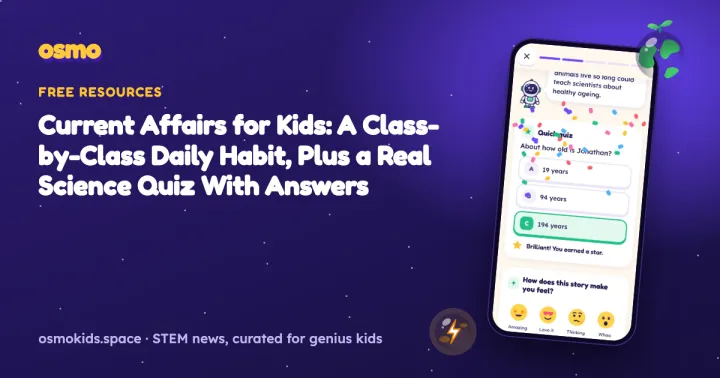
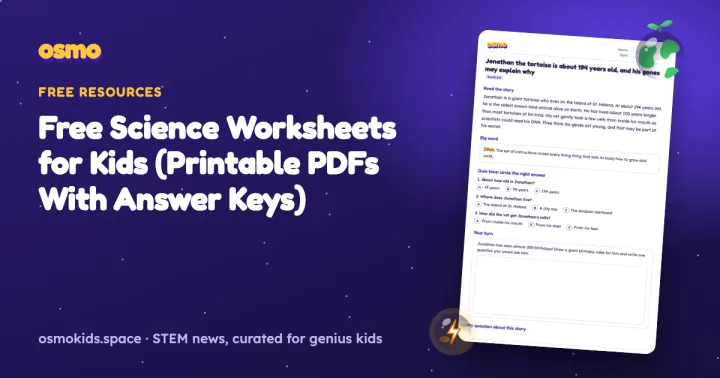
Quick answer
The best science news for kids comes from sources that name the scientists, link the original research and write at your child's reading level. Free, trusted options include Science News Explores, Frontiers for Young Minds, Science Journal for Kids and NASA's kids' sites. Reading one story together, with a few good questions, matters more than reading many.
- Under 8: NASA Kids' Club, NASA Space Place, short stories read aloud.
- Ages 8 to 11: Frontiers for Young Minds, DOGOnews, kid-level news apps.
- 11 and up: Science News Explores, Science Journal for Kids, then the original press release.
- Use the question script below: five minutes, three questions, one "how do they know?"
Want more? Our free worksheet library adds a printable STEM worksheet for every new science story we publish, sorted by class (K to Class 2, Class 3 to 5, Class 6 to 8), topic and language (Hindi), each with an answer key.
Searching for science news for kids usually turns up two kinds of pages: thin lists that repeat the same five names, and adult science sites that a nine-year-old will bounce off in a minute. This guide is different. We opened every source below, checked who makes it, what age it suits and whether it is free, and then added what most lists leave out: how to actually read a science story with a child so it turns into thinking, not just facts.
We make Osmo, a daily science news app for kids, so we have a view. We will tell you where Osmo fits, but most of this page is about other sources, because the right answer for your family may be a mix.
Free science news for kids: trusted sources by age
Here is our checked list. "Best age" is our guide based on what each publisher says about its own audience.
| Source | Who makes it | Best age | Cost | Why it is good |
|---|---|---|---|---|
| NASA Kids' Club | NASA | Pre-K to Grade 4 | Free | Games, photos from missions and "Now in Space", which introduces the astronauts on the International Space Station. |
| NASA Space Place | NASA | Primary years | Free | Explainers on Earth, the Sun and the universe, crafts, games, a glossary and a Spanish version. |
| Frontiers for Young Minds | Frontiers, as a journal for young readers | About 8 to 15 | Free, open access | Scientists write the articles; reviewers aged 8 to 15, guided by a science mentor, help improve them before publication. |
| DOGOnews | DOGOnews | Grades 2 and up | Articles readable without a login; check the site for current plans | Kids' news with a Science section, a built-in dictionary for hard words and maps. |
| Science News Explores | Society for Science (non-profit) | Middle school and up | Free online | Real science journalism across life, Earth, space and tech, plus explainers, experiments and a "Word of the Week". |
| Science Journal for Kids | Non-profit | Elementary to high school, sorted by reading level | Free | Research papers adapted for students and approved by scientists, many translated into more than 20 languages. |
| Space Scoop | ESO with the Universe Awareness project | About 7 to 11 | Free | Child-friendly versions of astronomy press releases. |
| ScienceDaily | ScienceDaily | Grown-ups (to pre-read) | Free, ad-supported | Daily stories selected from press materials from hundreds of sources, with links to the original journal papers. |
| Osmo (our app) | Neobound AI, India | About 5 to 14 | Free daily edition; optional Plus | Five stories a day from publishers like NASA, ESA and ScienceDaily, rewritten at three reading levels, each crediting its source. |
Every source in the table offers science news for kids free of charge at its core, so you can try several before settling on a favourite. If you are weighing up apps as well as websites, our guide to safe news sites for kids compares more options on ads, chat features and reading level.
Science news for kids this week: what real stories look like
It helps to see what good kids' science news actually reads like. Here are three real stories from Osmo editions this week, quoted at the Grades 3 to 5 level, each rewritten from a named publisher.
Deep sleep (from ScienceDaily): "When you are in deep sleep, your body sends out growth hormone. It is a chemical messenger that helps build muscles and strong bones. Scientists already knew that too little sleep can mess this up, but not how the brain controls it."
A sharper space telescope (from ScienceDaily): "Engineers moved one of its mirrors by a tiny amount, just one-sixteenth the width of a human hair. That small change lined everything up almost perfectly. Now its main camera makes pictures nearly 30% sharper than expected."
A 194-year-old tortoise (from Singularity Hub): "His vet gently took a few cells from inside his mouth so scientists could read his DNA. They think his genes act young, and that may be part of his secret."
Notice what these have in common. Each names who did the work, gives one concrete number or detail, and uses words like "think" and "may" when scientists are not certain yet. That last habit is gold. It quietly teaches that science is a process of finding out, not a list of finished facts.
For space stories specifically, including this month's Mars moon mission, see our guide to space news for kids.
How to read a science story with your child: a 10-minute script
Research on reading comprehension backs a simple idea: talking about a text, with questions that make children think, helps them understand and remember it. A US government practice guide for kindergarten to Grade 3 recommends teaching strategies such as activating prior knowledge, questioning, visualising and retelling, and guiding focused discussion about meaning. A second guide rates asking "deep explanatory questions", such as "what caused this?" and "how do we know?", as backed by strong evidence.
Here is how that looks at the kitchen table. Use the deep sleep story above as a practice run.
Before reading (1 minute)
- "The headline says deep sleep helps your body grow. What do you already know about sleep?"
- "What do you think scientists might have discovered?"
While reading (3 minutes)
- Stop at one tricky word. "Hormone: what do you think that means from the sentence around it?"
- "Can you picture it? Draw in the air where in your body this happens."
After reading (5 minutes)
- Retell: "Tell me the story in two sentences, as if I had not read it."
- Cause: "Why does deep sleep matter for growing?"
- How do they know? "Who found this out? What did they study?"
- Check the source: Open the original together. In this case the ScienceDaily article says the experiments were done in mice and that more research is needed to know how it applies to people. That is a perfect lesson in why the original matters.
- Wonder: "What would you ask the scientists next?"
Checking the original is not just a science skill. In a Stanford study of about 500 high school students, six short lessons in reading "laterally", leaving a page to check who is behind it and what other sources say, made students twice as likely to spot questionable websites. Starting the habit gently with a ten-year-old gives them a head start.
Why science news builds scientific thinking
School science teaches what we know. Science news shows how we come to know it, and that is the part children rarely see. Every good story has a question, a method, a finding and a "we are not sure yet". That is the shape of scientific thinking.
International assessments describe the same skills. The OECD's PISA science framework groups scientific literacy into three competencies: explaining phenomena scientifically, evaluating and designing scientific enquiry, and interpreting data and evidence scientifically. A short news story touches all three. Your child sees an explanation, meets a method ("they took a few cells from inside his mouth") and weighs evidence ("they think", "may").
India's National Education Policy 2020 names "scientific temper and evidence-based thinking" among the skills all students should learn. NCERT material describes a person with scientific temper as someone who enquires and searches for evidence and reasons before accepting anything. Reading real science news, and asking "how do they know?", is a daily, low-pressure way to practise exactly that.
There is a memory benefit too. The US Institute of Education Sciences rates using quizzes to re-expose students to key content as backed by strong evidence. A two-minute quiz after a story is not busywork; it helps the ideas stick.
Science news for kids in India
Indian parents often want two things: global science and Indian science, ideally without a pile of ads. Some good starting points:
- ISRO's Students page lists programmes for school children, including YUVIKA and a STEM portal with courses, video sessions with space scientists, a virtual museum and a space quiz.
- Indian research in global feeds. Sites like ScienceDaily carry discoveries from Indian institutes. This week Osmo's kids' edition included a story from the Indian Institute of Science on using AI to study how carbon dioxide could be turned into fuel.
- Hindi. Most free kids' science sites are English-only. Osmo Plus offers stories in Hindi, which helps bilingual families and Hindi-medium learners.
- School links. A story about growth hormone pairs naturally with lessons on the human body; a telescope story fits units on light and space.
For a broader look at Indian options beyond science, see our guide to the news app for kids in India.
Science articles for kids: an age-by-age guide
| Age | What works | Questions to ask |
|---|---|---|
| 5 to 7 (K to Grade 2, Class 1 to 2) | Three-sentence stories read aloud, a picture, one new word | "What happened?" "What was the new word?" "Can you draw it?" |
| 8 to 10 (Grades 3 to 5, Class 3 to 5) | Short news stories they read alone, plus a 3-question quiz | "Who found this out?" "Why does it matter?" "What would you ask next?" |
| 11 to 14 (Grades 6 to 9, Class 6 to 9) | Longer articles with numbers, journal names and caveats | "What was the sample?" "Was it animals or people?" "What do other sources say?" |
Here is how one real Osmo story reads for a five-year-old: "When you sleep deeply, your body makes a helper called growth hormone. It helps your muscles and bones grow strong. So a good night's sleep really helps you grow." The older version adds that the work came from the University of California, Berkeley, and was published in the journal Cell. Same facts, different depth.
Where Osmo fits
We built Osmo for parents who want science news for kids today, every day, without an endless feed. Each day there is a short edition of five stories from real science and technology publishers, never social media, and each story credits and links its source. AI rewrites each story at three reading levels using only facts from the original, and a person on our team approves every story before children see it. A word filter and an AI editor leave out war, crime, politics and frightening topics.
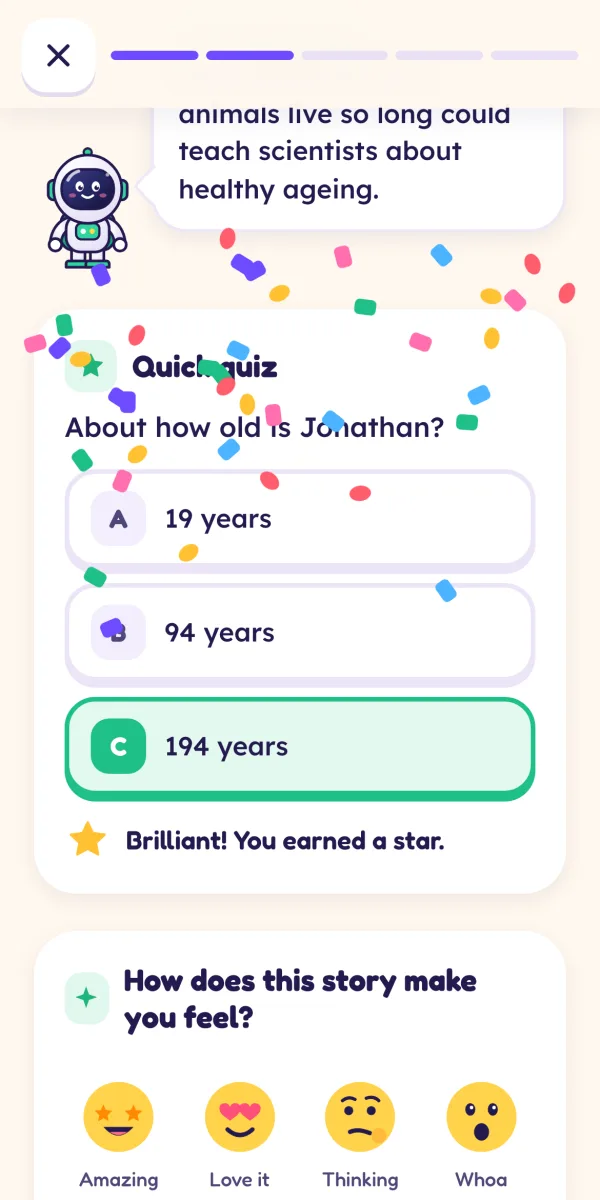
There are no ads, no accounts, no chat between users and no streaks, on purpose. The free version includes today's five stories, all three reading levels, read-aloud, quizzes and the last seven days. Osmo Plus adds the full archive, Hindi stories and printable worksheets for every story. You can read more about our approach for grown-ups and our privacy policy. If you want a printable start right now, our free science worksheets come with answer keys.
As Vivvan, Archsha and Aditya, some of our early Osmo explorers, and their families put it: "We are loving this app, happy to be a part of the STEM world of Osmo!" Whatever source you choose, the habit is what counts: one real story, a few good questions, and a child who learns to ask "how do they know?"
Frequently asked questions
What is the best free science news for kids?
It depends on age. For children up to about Grade 4, NASA Kids' Club and NASA Space Place are free and built for young readers. From middle school, Science News Explores is free online. Frontiers for Young Minds and Science Journal for Kids publish free articles based on real research. Osmo's free version gives five kid-level science stories a day at three reading levels.
Where can I find science news for kids today?
For something new every day, look for sources that date their stories clearly. Science News Explores is a free online science news publication for middle school and up, and Osmo puts out a fresh edition of five science and technology stories each day, rewritten from publishers such as NASA, ESA and ScienceDaily. Always check the date on a story and the original source it links to.
Is there science news for kids in India?
Yes. ISRO's Students page lists programmes and a STEM portal for school children, and many global kids' sites cover Indian research too. Osmo is made in India, includes discoveries from Indian institutes such as IISc, and offers stories in Hindi with Osmo Plus. CBSE and NCERT classrooms can use these stories to support the scientific temper that NEP 2020 asks schools to build.
At what age can a child start reading science news?
Children as young as five can enjoy a science story read aloud if it is short and calm, with a picture and one new word. By ages 8 to 10 most children can read a short news story alone and answer questions about it. From about 11, they can start comparing sources and asking how scientists know what they claim.
How do I know if a science article for kids is reliable?
Check three things. Does it name the scientists, the institution or the journal? Does it link to an original source you can open? Is it dated? Reliable kids' science articles usually answer all three. Then check the original for details the short version left out, such as whether a study was done in animals or people.
Sources
- Science News Explores (Society for Science): About and homepage
- Frontiers for Young Minds: About
- Science Journal for Kids: homepage
- NASA Kids' Club
- NASA Space Place
- TeachersFirst review: DOGOnews
- ScienceDaily: About This Site
- ESO announcement: Space Scoop, astronomy news for children
- ISRO: Students
- NCERT CIET presentation quoting NEP 2020 on scientific temper and evidence-based thinking
- Scottish Government: PISA 2015 highlights (PISA science competencies)
- IES Practice Guide: Organizing Instruction and Study to Improve Student Learning (NCER 2007-2004)
- IES/WWC Practice Guide: Improving Reading Comprehension in Kindergarten Through 3rd Grade (NCEE 2010-4038)
- Stanford Graduate School of Education: It doesn't take long to learn how to spot misinformation online
- ScienceDaily: How deep sleep drives growth hormone release (UC Berkeley)
- ScienceDaily: NASA's Roman Space Telescope sharper than expected
- ScienceDaily: AI maps how CO2 turns into fuel on copper (IISc)
- Singularity Hub: The oldest living land animal is 194
Written and fact-checked by the Osmo Editorial Team. Osmo is not affiliated with the apps, publishers or organisations mentioned. Spotted something out of date? Tell us.