Quick answer
Safe news sites for kids are written for children, name their sources, show no ads, collect little or no personal data, have no open chat or comments, and have a clear policy on frightening topics. No site is perfect for every age, so preview stories, start gentle, and talk about what your child reads.
- Use the 12-point checklist below on any site or app.
- Under 7: keep frightening news away (Common Sense Media).
- Ask what they have heard first, then share calm, basic facts (AAP).
- Teach one habit early: "Who says so, and how do they know?"
Most parents searching for safe news sites for kids are reacting to something: a headline overheard on the car radio, a video shared at school, a question at bedtime that was hard to answer. You want your child informed and curious, not frightened. This guide gives you a practical checklist to judge any kids news site in five minutes, real options sorted from gentlest to most grown-up, and what to say when the news is scary.
Disclosure: we make Osmo, a science news app for kids. We have tried to write the checklist so it is just as useful for judging other sites, including ours.
Why "safe news for kids" is not just about content
When parents think about safe news for kids, they usually think about violent stories. That matters a lot. In a 2017 Common Sense Media survey of 853 US children aged 10 to 18, 63 percent said the news made them feel afraid, angry and/or sad. But a kids news site can be risky in four other ways too:
- Ads that lead off-site or sell to children.
- Trackers that collect data about what your child reads and does.
- Comments and chat that let strangers contact children.
- Weak sourcing, which teaches children that any claim is news. The same survey found only 44 percent of kids felt they could tell fake news from real.
Laws are moving in the same direction. In the US, COPPA covers online services directed to children under 13. India's Digital Personal Data Protection Act 2023 says services "shall not undertake tracking or behavioural monitoring of children or targeted advertising directed at children". You do not need to read the law to use that as your standard.
The parent safety checklist for safe news sites for kids
Open the site or app yourself and work through this list. It takes about five minutes.
| # | Check | How to check | Green flag |
|---|---|---|---|
| 1 | Written for kids | Read two stories | Short sentences, explained words, child-relevant angles |
| 2 | Scary-topic policy | Look for an "About" or "For parents" page | It says plainly what it covers and how |
| 3 | Ads | Scroll a story page fully | No ads, no "sponsored" stories |
| 4 | Tracking | Read the privacy policy or app store privacy label | No third-party trackers or ad networks |
| 5 | Personal data | Try signing up | No child email, phone or real name needed |
| 6 | Comments and chat | Look under stories and in profiles | None, or moderated and not public |
| 7 | Named sources | Look at the end of a story | Credits and links to the original reporting |
| 8 | Real people in charge | About page | Named editors or an organisation you can contact |
| 9 | Images | Browse a week of stories | No graphic photos or autoplay video |
| 10 | Exit links | Tap links in stories | They do not drop children onto adult sites |
| 11 | Grown-ups lock | Look for settings and purchases | Protected from children |
| 12 | A natural end | Use it for ten minutes | A fixed edition, not an endless feed |
Kid friendly news sites, from gentlest to most grown-up
"Safe" depends on your child. A seven-year-old and a twelve-year-old need different things. Here are real options, ordered by how much hard news they include. Details come from each service's own pages; check the latest versions with the checklist above.
- Science-only news. Osmo (ours) covers only science and technology. A word filter and an AI editor leave out war, crime, politics and frightening topics, and a person on our team approves every story before children see it. Science News Explores, from the nonprofit Society for Science, is free science journalism for readers from middle school on up.
- General news, carefully written. News-O-Matic's App Store listing says a child psychologist reviews each article and that the app is ad-free. It covers world events in age-appropriate language.
- Real news, told simply. NewsForKids.net, created by teacher Will Adams, covers world news in simple English, including a dedicated page on the Middle East war. Good for older primary children with a parent nearby.
- Real headlines for children. BBC Newsround covers serious stories alongside light ones; when we checked, its homepage included student protests in France. It also publishes an advice page for children upset by the news.
For a full side-by-side with prices, ages and formats, see our comparison of the best news app for kids options in 2026.
How to talk to kids about frightening news
Even with the safest news site for kids, big events reach children through school, friends and screens. The American Academy of Pediatrics (AAP) advice, written by paediatrician David Schonfeld, is clear and practical.
- Ask what they have heard. "Most children will have heard something, no matter how old they are," the AAP notes.
- Ask what questions they have, and how they feel. Then answer those questions, not the ones you fear.
- Share basic facts, not graphic details. Keep young children away from repeated graphic images and sounds.
- Do not be too vague. The AAP warns that something like "Something happened in a faraway town and some people got hurt" does not give a child enough to understand.
- Reassure. The AAP's suggested underlying message: "It's okay if these things bother you. We are here to support each other."
- Keep talking. "Children often do a good job of hiding their distress. Start the discussion early, and keep the dialogue going."
Scripts you can use
- Opening: "I heard some kids at school were talking about the news. What did you hear?"
- Checking feelings: "How did that make you feel? Lots of grown-ups feel worried too."
- Distance and safety: "That happened far from here. You are safe, and the people whose job it is to help are helping."
- Older kids: "Where did you see that? Let's check who reported it and what they actually know."
BBC Newsround gives children similar advice in their own words: talk to an adult you trust, remember it is normal to feel upset, and "try to balance the news you read", for example with a happier story before bed.
Age-by-age guidance
| Age | What Common Sense Media and the AAP suggest | What that means for news sites |
|---|---|---|
| 7 and under (up to about Class 2 / Grade 2) | Keep frightening news, pictures and video away. Reassure them the family is safe. Comfort and distraction help more than logic. | Science, nature and animal stories only, read together. |
| 8 to 12 (about Class 3 to 7) | Weigh maturity and temperament. Limit exposure for sensitive kids, because repeated coverage makes dangers seem bigger and closer. Ask what they know and correct inaccuracies. | Kid friendly news written for their age. Preview general news, and explain that outlets compete for clicks. |
| 13 and up | Check in, ask what they think, and do not dismiss their opinions. Talk about how to share views responsibly. | Real news sources with discussion about bias and sourcing. |
The AAP also notes that for a child with a developmental delay or disability, it helps to match your answers to their developmental level rather than their age.
Teaching kids to spot reliable news sources
The best long-term safety tool is a child who checks. Reliable news sources for kids model this every day by crediting where facts came from. Practise these four questions together:
- Who made this? A named publisher, scientist or reporter, or an anonymous account?
- How do they know? Was there a study, an expert, a document, a photo they took?
- Is it news, opinion or an advert?
- Who else is reporting it?
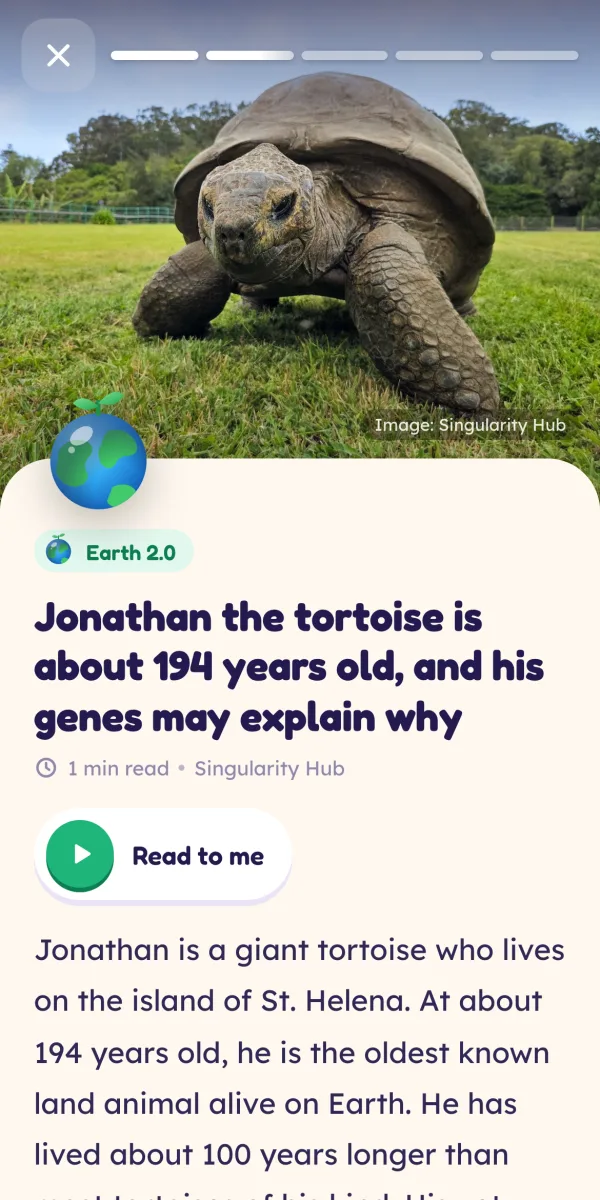
Every Osmo story ends with a credit and link to its original publisher, such as NASA, ESA or Phys.org, which gives children a natural moment to ask question 1. Any source that links its originals works the same way.
A safe daily news routine in ten minutes
The safest setup is less about finding perfect news websites for kids and more about how you use them. This routine works from about age 6 upwards.
- Same time, same place. Breakfast or after school, on a shared screen or in print, not alone in a bedroom.
- One to three stories. Let your child choose, but stop at the end of the edition.
- Two minutes of talk. "What surprised you? What would you ask the scientist?"
- Never just before bed if the story was about a real-world event. Swap in a nature or space story instead.
- Keep the door open. Once a week, ask: "Did you see or hear any news this week that was confusing or worrying?" That one question is how to talk to kids about scary news before it grows.
When a child needs more support
The AAP lists signs a child may be struggling after upsetting news, including sleep problems or nightmares, headaches or stomach aches, changes in eating, clinginess or acting younger, and lasting sadness, anxiety or fear. If you are concerned, the AAP suggests talking to your child's paediatrician, their teacher, or a school or community counsellor.
Building a calm news habit takes about ten minutes a day. Our current affairs for kids guide shows how by class, and our guide to educational screen time for kids covers how news fits into a healthy screen routine. Parents can read more about how we handle safety in the grown-ups section and our privacy policy.
Frequently asked questions
What is the safest news site for kids?
There is no single safest site for every child. For young children, the safest choice is a source that leaves frightening topics out entirely, such as a science-only service, read together. For older children, sites written for kids that cover real events carefully, such as News-O-Matic or BBC Newsround, can be safe when you preview stories and talk about them afterwards.
How do I know if a kids news site is reliable?
Reliable news sources for kids name where each fact came from, link to the original, separate news from opinion and correct mistakes openly. Check the About page for who writes and edits the stories. Be wary of sites with no named editors, no sources, sensational headlines or lots of ads. Teach your child to ask: who wrote this, and how do they know?
Should I let my child watch the news?
For children 7 and under, Common Sense Media advises keeping frightening news, pictures and video away. The AAP suggests keeping young children away from repeated graphic images and sounds. For older children, the AAP suggests previewing coverage first, then watching together so you can pause and talk. Kid friendly news written for their age is a gentler starting point.
How do I explain scary news to my child?
The AAP suggests starting by asking what your child has already heard, then asking what questions they have and how they feel. Share basic, accurate facts without graphic detail, correct misunderstandings, and reassure them about their own safety. Say it is okay to feel upset. Keep the conversation open, because children often hide worry.
At what age can kids read real news?
Most kids news services start around ages 6 to 8 with stories written for children. Common Sense Media's tips for ages 8 to 12 focus on matching exposure to your child's maturity and temperament, while teens aged 13 and up can usually handle real headlines with conversation. Move up gradually and watch how your child reacts.
Sources
- American Academy of Pediatrics (HealthyChildren.org): How to Talk With Kids About Tragedies and Other Traumatic News Events
- Common Sense Media: Explaining the News to Our Kids
- Common Sense Media: Best News Sources for Kids (updated 21 April 2026)
- Common Sense Media: News and America's Kids (2017 research)
- Tech & Learning: News and America's Kids key findings
- BBC Newsround: Advice if you're upset by the news
- US Federal Trade Commission: Children's Online Privacy Protection Rule (COPPA)
- Digital Personal Data Protection Act 2023 (India), Section 9
- Apple App Store: News-O-Matic: Reading for Kids
- Science News Explores (Society for Science)
- NewsForKids.net: About
- BBC Newsround (CBBC)
Written and fact-checked by the Osmo Editorial Team. Osmo is not affiliated with the apps, publishers or organisations mentioned. Spotted something out of date? Tell us.