Quick answer
The best way to teach children current affairs is a short daily habit: one or two child-friendly stories, a three-sentence retell, one new word and one question, in about ten minutes. Start with science, space and nature in Class 1 to 3, add discussion in Class 4 and 5, and real headlines gradually from Class 6.
- Ten minutes a day beats an hour on Sunday.
- Choose dated, sourced stories; GK lists go stale fast.
- Use the real October 2026 science quiz below, with answers.
- NEP 2020 lists current affairs among skills every student should learn.
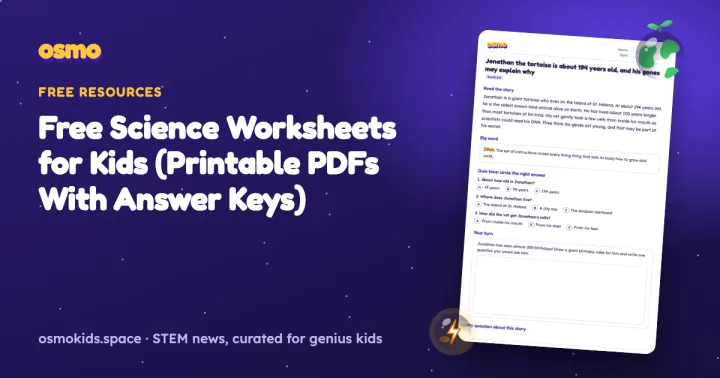
Want more? Our free worksheet library adds a printable STEM worksheet for every new science story we publish, sorted by class (K to Class 2, Class 3 to 5, Class 6 to 8), topic and language (Hindi), each with an answer key.
Search for current affairs for kids and you will find long lists of GK questions, many of them a year or two out of date. Lists have their place, but they do not build the thing that actually matters: a child who notices what is happening in the world, understands it and asks good questions about it.
This guide does two things. First, it gives you an evergreen, class-by-class method you can use any week of any year. Second, it gives you a real science current affairs quiz with answers, built only from stories published in mid-October 2026 by publishers such as ESA, ScienceDaily, Phys.org and Science News Explores. Every question names its source.
Why current affairs matter for children
India's National Education Policy 2020 lists the skills all students should learn. Alongside "scientific temper and evidence-based thinking", it includes "current affairs and knowledge of critical issues facing local communities, States, the country, and the world". It also asks schools to cut content to core essentials "to make space for critical thinking" and discussion-based learning.
Current affairs are perfect for this. Every story is a fresh, unseen passage for reading comprehension, a vocabulary lesson and a conversation starter. And because news changes daily, it trains children to update what they know, which is a skill no textbook can teach on its own.
The 10-minute daily current affairs habit
This routine works from Class 1 to Class 8. Only the reading level and the questions change.
- Read (4 minutes). One or two short stories written for children. Younger children listen; older children read aloud or silently.
- Retell (2 minutes). "Tell me what happened in three sentences: who, what, why it matters."
- One big word (1 minute). Pick one new word and use it in a sentence.
- One question (2 minutes). "What would you ask the scientist?" There is no wrong answer.
- Log it (1 minute). One line in a "news notebook": date, headline in their words, source.
One real story at three levels
Reading level matters more than topic. Here is one real story from Singularity Hub, about Jonathan the giant tortoise, as Osmo rewrites it at three levels:
- Class 1 to 2: "Jonathan is a giant tortoise. He is about 194 years old! Scientists studied his body to learn why he has lived so long."
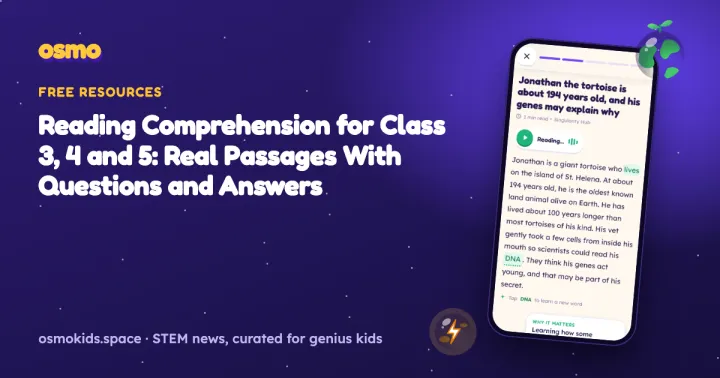
- Class 3 to 5: "Jonathan is a giant tortoise who lives on the island of St. Helena. At about 194 years old, he is the oldest known land animal alive on Earth. He has lived about 100 years longer than most tortoises of his kind."
- Class 6 to 9: "Jonathan, an Aldabra giant tortoise weighing about 400 pounds, is roughly 194 years old, which makes him the oldest known living land animal. He arrived on the island of St. Helena in 1882 as an adult..."
Current affairs for kids, class by class
| Class (US grade) | Topics | Daily dose | Good questions |
|---|---|---|---|
| Class 1 to 2 (K to Grade 2) | Animals, space, weather, inventions | 1 story, read aloud | "What was the animal? Where does it live?" |
| Class 3 (Grade 3) | Add the human body, Indian and world science | 1 to 2 stories | "Who found this out? How?" |
| Class 4 (Grade 4) | Add technology, energy, young inventors | 2 stories | "Why does this matter to people?" |
| Class 5 (Grade 5) | Add climate, health research, startups | 2 to 3 stories | "What might happen next? What is still unknown?" |
| Class 6 to 8 (Grades 6 to 8) | Add real-world headlines, discussed together | 2 to 3 stories plus one weekly long read | "Who reported this? What is fact and what is opinion?" |
Current affairs for kids Class 3
Class 3 is where children start reading news on their own. Keep stories concrete: a tortoise, a rescued walrus, a spacecraft. Ask for a retell before any quiz, because retelling shows understanding better than multiple choice. Our guide to reading comprehension for Class 3 has more question types.
Current affairs for kids Class 5
By Class 5, push for the "how do they know?" step. Many science stories mention the university, the journal or the method. A Class 5 child can learn to spot those and say why they matter.
A note for Class 6 to 8
Older children will meet real-world headlines anyway, so it is better they meet them with you. Common Sense Media suggests asking what they already know, correcting inaccurate facts and explaining that news outlets compete for clicks. For upsetting events, the AAP advises sharing basic facts without graphic detail. Our guide to safe news sites for kids covers how to handle frightening stories.
Science current affairs quiz with answers (October 2026)
These are current affairs for kids with answers you can check: every question below comes from a real story published in mid-October 2026, with the original publisher named. The questions are the same ones children answer in Osmo. Read the story summary aloud first if your child has not seen it. Answers are at the end of each set.
Set A: Class 3 level (about ages 8 to 9)
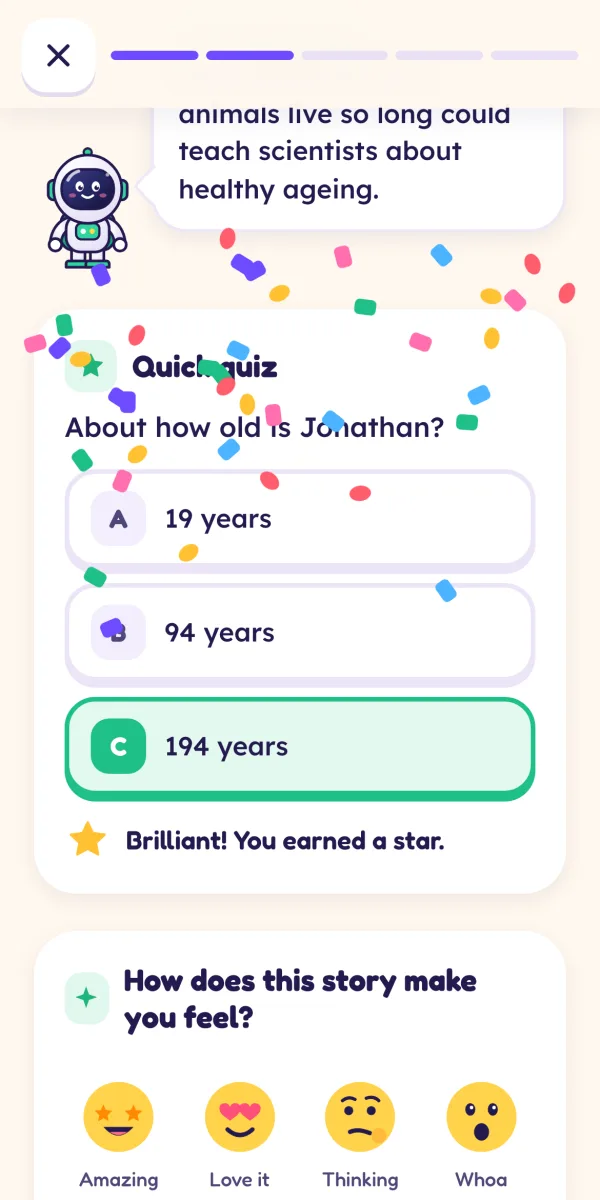
- Jonathan the tortoise (Singularity Hub). About how old is Jonathan? (a) 19 years (b) 94 years (c) 194 years
- Jonathan the tortoise (Singularity Hub). Where does Jonathan live? (a) A city zoo (b) The island of St. Helena (c) The Amazon rainforest
- A rescued baby walrus (Popular Science). Where did the scientists keep the walrus calf safe from the storm? (a) In a boat (b) In an empty building (c) In a cave
- Deep sleep (ScienceDaily). What does growth hormone help build? (a) Muscles and bones (b) Hair colour (c) Teeth fillings
- Your pupils (Popular Science). What happened to people's pupils when they counted out loud? (a) They got bigger (b) They got smaller (c) They changed colour
- Saturn's moon Enceladus (Phys.org). Where is the ocean on Enceladus? (a) Under thick ice (b) On top of a volcano (c) Inside a cloud
- A Mars moon mission (ESA). Which moon is the MMX spacecraft going to visit? (a) Our Moon (b) Phobos, a moon of Mars (c) A moon of Saturn
- A young inventor (TechCrunch). How long can one braided hairstyle take? (a) Ten minutes (b) About eight hours (c) Three days
Answers, Set A: 1 (c) 194 years. 2 (b) St. Helena. 3 (b) In an empty building. 4 (a) Muscles and bones. 5 (a) They got bigger. 6 (a) Under thick ice. 7 (b) Phobos. 8 (b) About eight hours.
Set B: Class 5 level (about ages 10 to 11)
- NASA's Roman Space Telescope (ScienceDaily). How much did engineers move one of its mirrors? (a) One metre (b) One-sixteenth the width of a hair (c) Half a centimetre
- Roman Space Telescope (ScienceDaily). What will Roman help scientists study? (a) Dark matter and dark energy (b) Ocean fish (c) Volcanoes on Earth
- MMX mission (ESA). Which country's space agency leads MMX? (a) Japan (b) Brazil (c) Canada
- Mantis shrimp (Phys.org). About how many visual pigments does a mantis shrimp have? (a) 3 (b) About 30 (c) About 300
- Deep sleep (ScienceDaily). Which university did this sleep research? (a) University of California, Berkeley (b) University of Tokyo (c) University of Delhi
- CO2 into fuel (ScienceDaily). Which metal did the reactions happen on? (a) Gold (b) Copper (c) Iron
- CO2 into fuel (ScienceDaily). Where did the scientists in this story work? (a) Indian Institute of Science (b) NASA (c) MIT
- Superconductors (ScienceDaily). What did the one-atom-high steps act like? (a) Railway tracks (b) Walls (c) Mirrors
- AI and our skills (Science News Explores). When can AI help our skills grow? (a) When it does all the work (b) When we learn from its feedback (c) Never
- A startup fighting fakes (TechCrunch). What does the Veritas chip do? (a) Plays music (b) Shows an item is real (c) Makes items lighter
Answers, Set B: 1 (b) One-sixteenth the width of a human hair, and its pictures came out nearly 30% better than expected. 2 (a) Dark matter and dark energy. 3 (a) Japan (JAXA leads, with NASA, CNES, DLR and ESA). 4 (b) About 30; humans have 3. 5 (a) UC Berkeley. 6 (b) Copper. 7 (a) Indian Institute of Science, Bengaluru, which found 9,389 tiny chemical steps. 8 (a) Railway tracks. 9 (b) When we learn from its feedback. 10 (b) It shows an item is real, not a counterfeit.
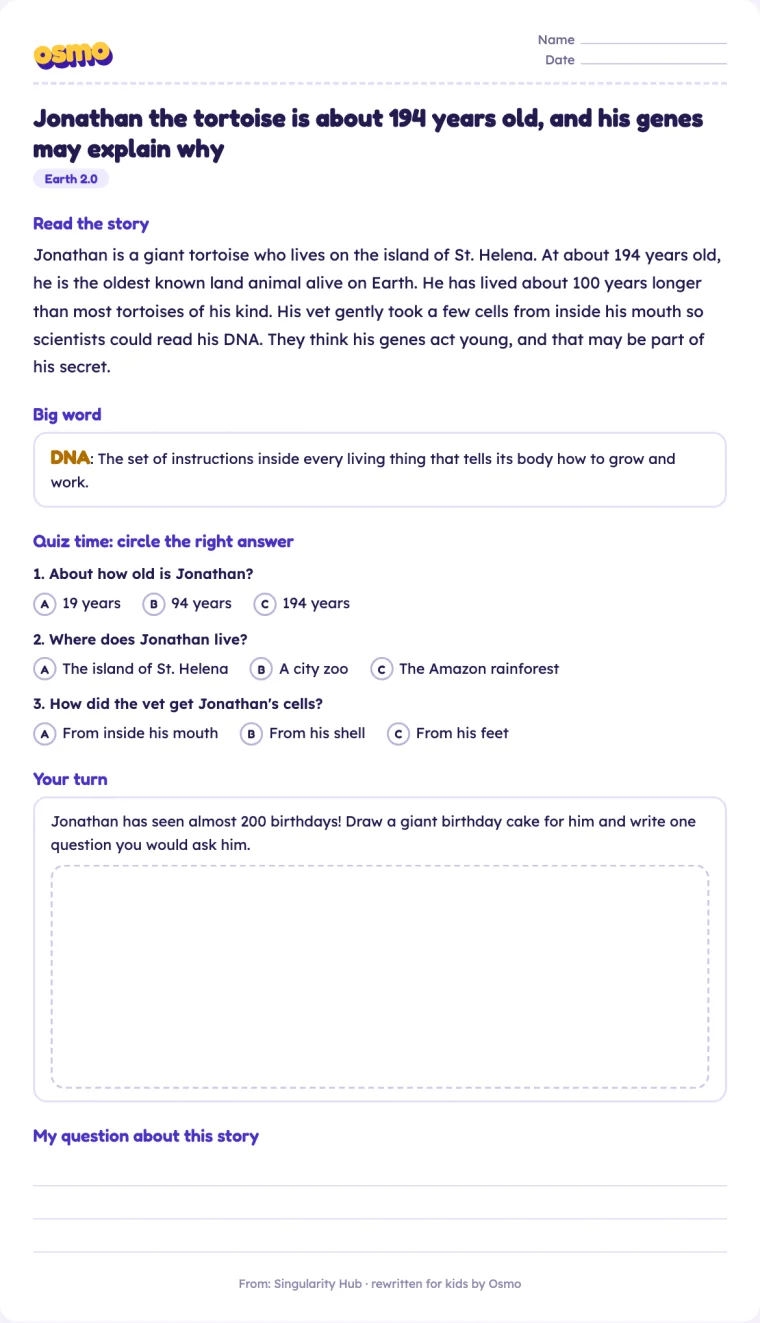
Want these on paper? Print the free tortoise worksheet (Grades 3 to 5), the deep sleep worksheet or the Mars moon mission worksheet (Grades 6 to 9). More are on our worksheets page.
Turning current affairs into general knowledge for kids
News fades; knowledge stays when children connect it to something. Three simple tools help.
- A world map on the wall. Put a sticker where each story happened: St. Helena, Alaska, Japan, Bengaluru. After a month, the map becomes a geography lesson.
- A big-word wall. Words like "hormone", "catalyst" and "sample" from real stories stick better than words from lists.
- "Then and now" links. Connect each story to something lasting: the Roman telescope to what a telescope is, the tortoise to how DNA works.
Keeping current affairs fresh and honest in 2026
The problem with most current affairs for kids 2026 lists is that they are written once and never updated. Before you use any quiz, check three things:
- Is it dated? A question without a date can quietly become wrong.
- Is the source named? If you cannot see where a fact came from, your child cannot learn to check it.
- Is it suitable? Many adult GK lists include wars, disasters and crime. For younger children, science and nature are the gentler path, as Common Sense Media advises keeping frightening news away from children aged 7 and under.
A kids news service that adds a short quiz to every story saves you making your own. Osmo, our app, does this with three questions per story, five stories a day, and no streaks, on purpose, so missing a day never feels like failure. See our comparison of the best news app for kids for other options.
Common mistakes to avoid
- Too much at once. Ten stories on Sunday will not stick. Two a day will.
- Quiz before talk. Retelling and questions first, quiz second.
- Adult news for young children. Save real-world headlines for when your child is ready, and discuss them together.
- Turning it into homework. Keep it short, curious and fun. If your child asks a question you cannot answer, look it up together. That is the habit you are really building.
Frequently asked questions
How can kids learn current affairs daily?
Keep it small and regular. Read one or two short stories written for children at the same time each day, ask your child to retell the story in three sentences, note one new word, and ask one question. Ten minutes is enough. A weekly family quiz on the week's stories turns the habit into general knowledge that sticks.
What current affairs should a Class 3 child know?
A Class 3 child does not need politics or economics. Focus on stories they can picture: animals, space missions, inventions, the human body and their own country's achievements. They should be able to say what happened, where, and why it matters in simple words. Science and nature stories are ideal at this age because they are concrete and rarely frightening.
Where can I find current affairs for kids with answers?
Many GK websites publish question lists, but check the date, because current affairs go stale quickly. Better options are kids news services that add quizzes to each story, such as Osmo's three-question quiz, or making your own from a kids newspaper. This page includes a real science current affairs quiz with answers built from stories published in October 2026.
Is general knowledge the same as current affairs?
Not quite. General knowledge for kids covers lasting facts, such as capitals, planets, inventors and national symbols. Current affairs are recent events: a new space mission, a discovery, a record. They overlap, because today's news often teaches lasting facts. A story about a Mars moon mission, for example, also teaches that Mars has two moons, Phobos and Deimos.
At what age should kids start current affairs?
Children can start from about Class 1 (age 5 or 6) with very short, gentle stories read aloud, focusing on animals, space and nature. Common Sense Media advises keeping frightening news away from children aged 7 and under. From Class 3 or 4, children can read short stories on their own and discuss them, and real-world headlines can follow gradually from about Class 6.
Sources
- Ministry of Education / PIB: NEP 2020 full text in resource book (paras 4.5 and 4.23)
- Common Sense Media: Explaining the News to Our Kids
- American Academy of Pediatrics (HealthyChildren.org): How to Talk With Kids About Tragedies and Other Traumatic News Events
- ScienceDaily: deep sleep and growth hormone (October 2026)
- ScienceDaily: Nancy Grace Roman Space Telescope sharper than planned (October 2026)
- ScienceDaily: atom-high steps steer vortices in superconductors (October 2026)
- ScienceDaily: IISc uses AI to map CO2-to-fuel reactions on copper (October 2026)
- ESA: Mars moon lander set to launch on 19 October (13 October 2026)
- Science News Explores: Is AI making us dumber?
- Popular Science: orphaned walrus calf rescued in Alaska
- Popular Science: pupils dilate depending on how you think
- Phys.org: salt crystals and the hidden ocean of Enceladus (October 2026)
- Phys.org: red-sensitive pigments of the mantis shrimp (October 2026)
- Singularity Hub: the oldest living land animal is 194 (15 October 2026)
- TechCrunch: Tressfecta and hair braiding (16 October 2026)
- TechCrunch: Veritas chip to verify luxury goods (16 October 2026)
Written and fact-checked by the Osmo Editorial Team. Osmo is not affiliated with the apps, publishers or organisations mentioned. Spotted something out of date? Tell us.