Quick answer
Good reading comprehension for Class 3 starts with short, interesting passages and questions that go beyond "find the word". Below are four real non-fiction passages for Class 3 to 5 (Grades 3 to 5), each with questions and an answer key, plus the strategies research supports and how to raise the challenge each year.
- Class 3: find answers in the text, retell, learn one new word.
- Class 4: put events in order, explain why, use clues for word meanings.
- Class 5: infer, follow cause and effect, judge how certain a claim is.
- Ten minutes of talk after reading matters more than a long worksheet.
Want more? Our free worksheet library adds a printable STEM worksheet for every new science story we publish, sorted by class (K to Class 2, Class 3 to 5, Class 6 to 8), topic and language (Hindi), each with an answer key.
Most pages offering reading comprehension for Class 3 give you a made-up story about a seed or a rainy day, ten questions and no guidance. Those can be useful, but children often switch off because nothing is at stake. The passages below are different: they are real science news stories, rewritten for 8 to 10 year olds from named publishers, about a 194-year-old tortoise, a shrimp with super-vision, a baby walrus rescue and Indian scientists turning carbon dioxide into fuel.
The passages come from Osmo, our science news app for kids, which rewrites every story at three reading levels. Each passage here is quoted exactly at the Grades 3 to 5 level, and we checked the facts against the original articles.
Reading comprehension for Class 3: why it is the turning point
India's NIPUN Bharat mission calls Grade 3 the point by which children are expected to "learn to read" so that they can "read to learn" after that. Its goal is that by Grade 3 every child can read with comprehension, and its targets include reading with meaning at about 60 words per minute or more by the end of Grade 3. NIPUN describes reading comprehension as constructing meaning from a text and thinking critically about it, including retrieving information and interpreting it.
There is still work to do. In ASER 2024, a survey of rural India, 27.0% of children in Class 3 could read a Class 2 level text, up from 20.5% in 2022. Among Class 5 children, 48.8% could. If your child reads fluently but struggles to explain what they read, that is common and very fixable. The US equivalent, reading comprehension for 3rd grade, faces the same shift: from decoding words to understanding ideas.
Reading comprehension strategies that research supports
A US Institute of Education Sciences practice guide for kindergarten to Grade 3 reviewed the research and made five recommendations. The first, teaching comprehension strategies, has strong evidence behind it. Here they are in parent-friendly form.
| Recommendation | What it looks like at home |
|---|---|
| 1. Teach comprehension strategies (strong evidence) | Predict from the title, ask questions while reading, picture it, stop and fix confusion, infer, then retell. |
| 2. Teach text structure (moderate evidence) | Ask "Is this a story, or is it explaining something? What happened first? What caused what?" |
| 3. Guide focused discussion (minimal evidence) | Ask questions that need thinking, then follow up: "What makes you say that?" |
| 4. Choose texts on purpose (minimal evidence) | Use several genres, including non-fiction, at the right difficulty. |
| 5. Make reading engaging (moderate evidence) | Give choices, celebrate success, read with a sibling or friend. |
The guide found that strategies like activating prior knowledge, visualising, inference and retelling each had positive effects in studies. It also makes a point worth remembering: worksheets on their own rarely teach children what to do in their heads while reading. The talk is the teaching. A second IES guide rates asking "deep" questions, such as "what caused this?" or "what if?", as supported by strong evidence.
Reading comprehension passages with questions
Print these or read them on screen. Passages 1 and 2 work well as comprehension passages for Class 3, and Passages 3 and 4 stretch into Class 4 and 5. Each passage has three multiple-choice questions (from the original Osmo quiz) and three thinking questions we added. Answer keys follow each passage.
Passage 1: Jonathan the tortoise (Class 3, Grade 3)
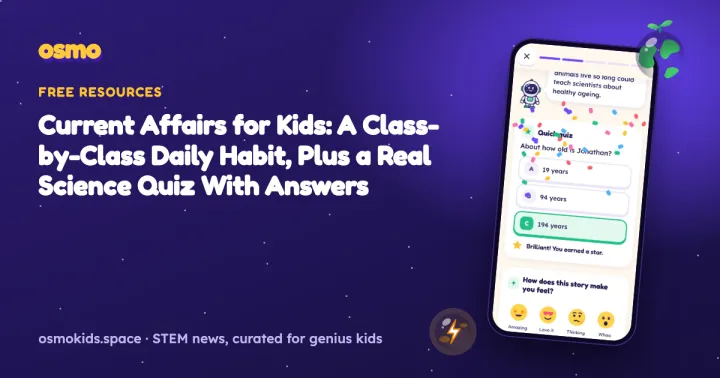
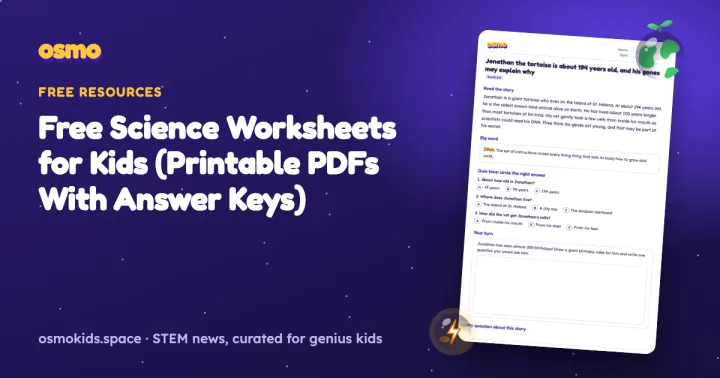
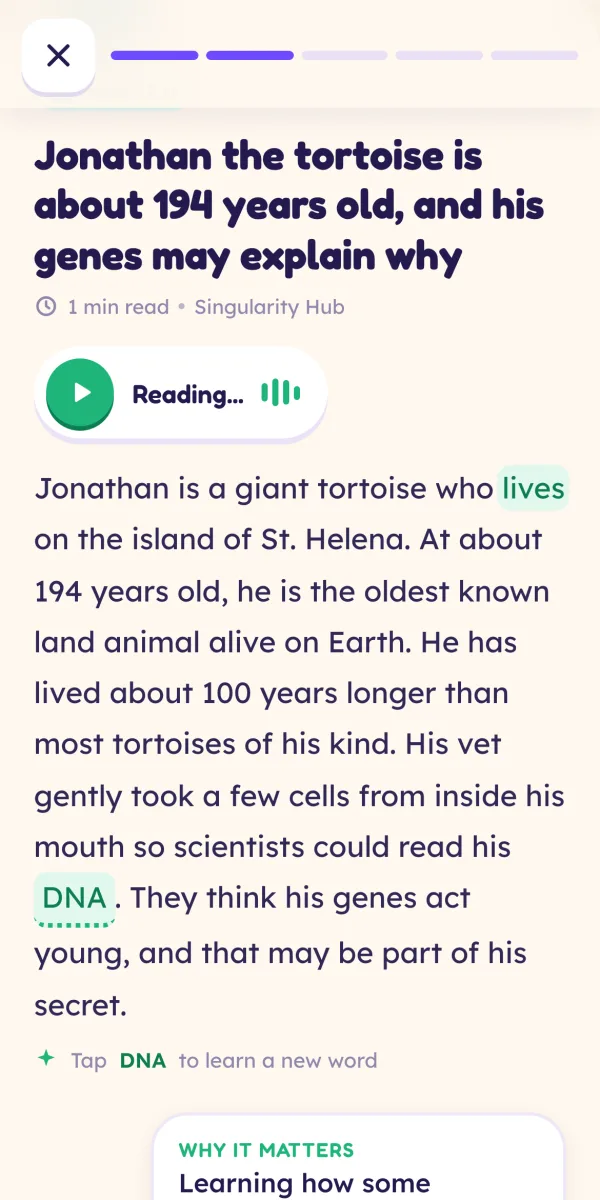
Jonathan is a giant tortoise who lives on the island of St. Helena. At about 194 years old, he is the oldest known land animal alive on Earth. He has lived about 100 years longer than most tortoises of his kind. His vet gently took a few cells from inside his mouth so scientists could read his DNA. They think his genes act young, and that may be part of his secret.
- About how old is Jonathan? (a) 19 years (b) 94 years (c) 194 years
- Where does Jonathan live? (a) the island of St. Helena (b) a city zoo (c) the Amazon rainforest
- How did the vet get Jonathan's cells? (a) from inside his mouth (b) from his shell (c) from his feet
- About how many years longer has Jonathan lived than most tortoises of his kind?
- Why did the vet take cells from Jonathan?
- Find two words in the last sentence that show scientists are not completely sure.
Answer key: 1. (c) 2. (a) 3. (a) 4. About 100 years. 5. So scientists could read his DNA and learn why he has lived so long. 6. "think" and "may".
Passage 2: The shrimp with super-vision (Class 3 to 4)
People's eyes use 3 special colour detectors, called pigments. The mantis shrimp has about 30. For the first time, scientists in Belgium and Germany studied these pigments one by one. They found that some of them can detect a kind of red light that very few animals can see. The discovery could help scientists who use light to control cells.
- About how many visual pigments does a mantis shrimp have? (a) 3 (b) about 30 (c) about 300
- How many colour pigments do human eyes have? (a) 3 (b) 30 (c) 300
- Which countries were the scientists from? (a) India and Japan (b) Belgium and Germany (c) Brazil and Canada
- Using the passage, explain what a pigment is in your own words.
- About how many times more pigments does a mantis shrimp have than a person?
- What was new about this study? Which words tell you?
Answer key: 1. (b) 2. (a) 3. (b) 4. A colour detector in the eye. 5. About 10 times (30 compared with 3). 6. Scientists studied the pigments one by one; the words "For the first time" tell you.
Question 5 is a quiet maths link. Comprehension and numbers often meet in non-fiction, which is good practice for later classes.
Passage 3: Rescuing a baby walrus (Class 4, Grade 4)
Two researchers found a young walrus all by itself on a remote island in Alaska. It had no mother to look after it. They got permission from the local Inupiaq community and from wildlife officials to help it. The nearest marine animal centre was more than 800 miles away, and a storm kept them stuck on the island for days. They sheltered the calf in an empty building until they could take it to the Alaska SeaLife Center.
- Where did the scientists keep the walrus safe from the storm? (a) in a boat (b) in an empty building (c) in a cave
- How far away was the animal centre? (a) more than 800 miles (b) 5 miles (c) next door
- Who did the scientists ask for permission to help the calf? (a) the local Inupiaq community and wildlife officials (b) a TV channel (c) nobody
- Put these in order: the storm kept them stuck; they found the walrus; they took it to the Alaska SeaLife Center; they got permission to help.
- Why did the young walrus need help?
- The island is called "remote". Using clues in the passage, what do you think remote means?
Answer key: 1. (b) 2. (a) 3. (a) 4. They found the walrus; they got permission to help; the storm kept them stuck; they took it to the Alaska SeaLife Center. 5. It had no mother to look after it. 6. Far away from other places (the clue is that the nearest centre was more than 800 miles away).
Sequencing questions like number 4 are the heart of reading comprehension for Class 4. They check that a child has followed the order of events, not just spotted facts.
Passage 4: Indian scientists, AI and carbon dioxide (Class 5, Grade 5)
Carbon dioxide, or CO2, is a gas that traps heat around our planet. Scientists want to recycle it into fuels, the way you recycle paper. Researchers at the Indian Institute of Science used AI and computer simulations to study how CO2 changes on a piece of copper. They found 9,389 tiny chemical steps, including some that older models had missed. This could help scientists design better ways to make fuel from CO2.
- Which metal did the reactions happen on? (a) gold (b) copper (c) iron
- Where did the scientists in this passage work? (a) Indian Institute of Science (b) NASA (c) MIT
- How many chemical steps did they find? (a) 9,389 (b) 93 (c) 938,900
- The writer compares recycling CO2 with recycling paper. What does this comparison help you understand?
- Why might finding steps that "older models had missed" be important?
- Is it certain that this research will lead to better fuels? Which word tells you?
Answer key: 1. (b) 2. (a) 3. (a) 4. That CO2 is something people want to reuse and turn into something useful, instead of throwing it away. 5. Sample answer: if you know all the steps, you can plan better ways to turn CO2 into fuel; missing steps could lead to wrong predictions. 6. No, it is not certain; the word "could" tells you.
Questions 4 to 6 are what reading comprehension for Class 5 should feel like: understanding why a writer uses a comparison, reasoning about importance, and noticing how sure a claim is. There is no single perfect answer to question 5. Accept any answer your child can support from the text.
How to level up from Class 3 to Class 5
The clearest way to see progress is to compare one story at two levels. Here is the Osmo tortoise story for ages 5 to 7: "Jonathan is a giant tortoise. He is about 194 years old! Scientists studied his body to learn why he has lived so long." Compare it with Passage 1. The older version adds a place, a comparison ("100 years longer"), a method (cells from inside his mouth) and uncertainty ("think", "may"). Each of those is a new comprehension demand.
| Class 3 (Grade 3) | Class 4 (Grade 4) | Class 5 (Grade 5) | |
|---|---|---|---|
| Passages | Short, one main idea, familiar topics | Several events or facts, some new places and names | Informational texts with numbers, comparisons and caveats |
| Question types | Who, what, where; find the sentence; retell | Sequence; why; word meaning from clues | Infer; cause and effect; author's purpose; how certain |
| Text structure | Beginning, middle, end | Order of events, problem and solution | Cause and effect, compare and contrast |
| Independence | Read aloud together, then answer orally | Read alone, discuss after | Read alone, write short answers, check the source |
When reading comprehension for Class 3 feels easy, move up. A good sign is when your child answers the "find it" questions easily and starts giving reasons without being asked. Move back down for a week if they guess rather than point to the text. Progress is rarely a straight line, and that is fine.
A weekly comprehension routine for busy families
- Three times a week, ten minutes. One passage, the 4-question routine, done.
- Let your child choose. The IES guide recommends giving students reading choices. Animals one day, space the next.
- Read aloud for fluency. Have your child read one paragraph aloud. NIPUN Bharat describes fluency as reading with accuracy, speed and expression, together with the comprehension that lets children make meaning.
- Bring it back later. A week later, ask "Remember the walrus? Why was it stuck?" The IES study guide supports spacing review over time.
- Use Hindi or your home language too if your child learns in two languages. The same four questions work in any language.
If you prefer ready-made printables, our free science worksheets follow the same pattern, with a Grades 3 to 5 tortoise sheet and a deep sleep sheet, both with answer keys. For more passages, a new story every day is the easiest source of all: see our guide to science news for kids.
Where Osmo helps
Osmo gives children a short daily edition of five science and technology stories, each rewritten by AI at three reading levels (K to Grade 2, Grades 3 to 5 and Grades 6 to 9) using only facts from the original, and approved by a person on our team before children see it. Every story has a big word, a 3-question quiz and Read to me with word-by-word highlighting, and children can tap any word for its meaning. Because the same story exists at three levels, a Class 3 reader can step up to the Grades 3 to 5 version when ready, and a confident Class 5 reader can try the Grades 6 to 9 one.
There are no ads, no accounts and no chat between users. You can learn more on our grown-ups page. Whatever you use, keep the goal in sight: not more worksheets, but a child who reads a paragraph and has something to say about it.
Frequently asked questions
What should a Class 3 child be able to read?
India's NIPUN Bharat mission aims for every child to read with comprehension by the end of Grade 3, with a target of reading with meaning at about 60 words per minute or more. In practice, that means a Class 3 child should read a short, unfamiliar paragraph, retell it, and answer simple who, what, where and why questions about it.
How can I improve my child's reading comprehension at home?
Read short, interesting passages together several times a week. Before reading, ask what they already know. During reading, stop at one hard word. Afterwards, ask them to retell the passage in two sentences and answer one why question. US research rates teaching strategies like these, together with discussion about meaning, as effective for young readers.
What is the difference between Class 3 and Class 5 comprehension?
In Class 3, most questions can be answered by finding a sentence in the text. By Class 5, children should also infer things the text does not say directly, follow cause and effect, explain why an author uses a comparison and notice words like could or may that show how certain a claim is.
Are non-fiction passages good for reading comprehension?
Yes. Reading research recommends teaching comprehension with multiple genres, and informational texts teach structures that stories do not, such as cause and effect, problem and solution, and comparison. Real science news is a good source because it is short, current and naturally raises questions children want answered.
How long should a reading comprehension passage be for Class 4?
There is no single official length. What matters more is that the text is at the right difficulty for your child and interesting enough to talk about, which US reading research also recommends when choosing texts. The passages on this page are about 60 to 80 words each, short enough for one sitting and rich enough for five or six questions.
Sources
- Ministry of Education (PIB): NIPUN Bharat, National Mission on Foundational Literacy and Numeracy
- ASER Centre: ASER 2024 All India presentation (rural)
- IES/WWC Practice Guide: Improving Reading Comprehension in Kindergarten Through 3rd Grade (NCEE 2010-4038)
- IES Practice Guide: Organizing Instruction and Study to Improve Student Learning (NCER 2007-2004)
- Singularity Hub: The oldest living land animal is 194
- Phys.org: Red-sensitive pigments in mantis shrimp
- Popular Science: Scientists rescue an orphaned walrus calf in Alaska
- ScienceDaily: AI maps how CO2 turns into fuel on copper (IISc)
Written and fact-checked by the Osmo Editorial Team. Osmo is not affiliated with the apps, publishers or organisations mentioned. Spotted something out of date? Tell us.