Quick answer
Below are six printable science worksheets for kids, free as PDFs, each built on a real science news story. They cover K to Grade 9 (Class 1 to 9), one is in Hindi, and every sheet has a short story, a big word, three quiz questions and a hands-on activity. Answer keys are on this page.
- K to 2: Jonathan the tortoise, the rescued baby walrus.
- Grades 3 to 5: the tortoise, deep sleep, Saturn's moon (Hindi).
- Grades 6 to 9: Japan's Mars moon mission.
- Each takes about 10 to 15 minutes. Talk about it afterwards: that is where the learning happens.
Want more? Our free worksheet library adds a printable STEM worksheet for every new science story we publish, sorted by class (K to Class 2, Class 3 to 5, Class 6 to 8), topic and language (Hindi), each with an answer key.
Most printable science worksheets for kids online are colour-the-planet sheets or label-the-plant diagrams. They have their place, but they rarely connect science to the real world. These six are different: each one is built on a real discovery from the last few weeks, rewritten for children from a named publisher such as ESA, ScienceDaily or Popular Science. Your child reads about something that is actually happening in science right now.
We made these at Osmo, our science news app for kids. These science worksheets for kids are free to download and print, no sign-up needed, and you can open each one on a phone or print it at home or school.
Science worksheets for kids printable PDF list: all six at a glance
| Worksheet | Level | Topic | Big word | |
|---|---|---|---|---|
| Jonathan the tortoise | K to Grade 2 (ages 5 to 7) | Animals, ageing, DNA | DNA | Download |
| Baby walrus rescue | K to Grade 2 (ages 5 to 7) | Animals, caring for wildlife | orphaned | Download |
| Jonathan the tortoise | Grades 3 to 5 (ages 8 to 10) | Animals, ageing, DNA | DNA | Download |
| Deep sleep and growing | Grades 3 to 5 (ages 8 to 10) | Human body, hormones | hormone | Download |
| Saturn's moon Enceladus (Hindi) | Grades 3 to 5 (ages 8 to 10) | Space, oceans, crystals | क्रिस्टल (crystal) | Download |
| Mars moon mission (MMX) | Grades 6 to 9 (ages 11 to 14) | Space missions, sample return | sample | Download |
Each science worksheet PDF here follows the same layout. Every sheet has the same five parts: Read the story, Big word (one new word with a child-friendly meaning), Quiz time (three multiple-choice questions, circle the answer), Your turn (a drawing or hands-on task) and My question about this story, a blank space for your child's own question. The source is printed at the bottom of each sheet.
Worksheets for K to Grade 2 (ages 5 to 7)
1. Jonathan the tortoise (K to 2)
What it covers: a three-sentence story: "Jonathan is a giant tortoise. He is about 194 years old! Scientists studied his body to learn why he has lived so long." The big word is DNA. The facts come from a Singularity Hub report, which says Jonathan is the oldest known living land animal.
Your turn: draw a giant birthday cake for Jonathan and write one question to ask him.
Download: osmo-worksheet-tortoise-k2.pdf
Answer key: 1. C (194 years) 2. A (the island of St. Helena) 3. A (from inside his mouth)
Note: questions 2 and 3 go beyond the short K to 2 story, so read them together and use them as "let's find out" questions. The Grades 3 to 5 version of the story has the answers.
2. Baby walrus rescue (K to 2)
What it covers: "Two scientists found a baby walrus all alone on a beach. They kept it safe from a big storm. Then they took it to a special animal hospital." The big word is orphaned. The original Popular Science report describes a young walrus calf found near Point Lay, Alaska.
Your turn: draw the baby walrus safe and warm, then write three things a baby animal needs to grow up healthy.
Download: osmo-worksheet-baby-walrus-k2.pdf
Answer key: 1. B (in an empty building) 2. A (more than 800 miles) 3. A (the local Inupiaq community and wildlife officials)
Worksheets for Grades 3 to 5 (Class 3 to 5)
3. Jonathan the tortoise (Grades 3 to 5)
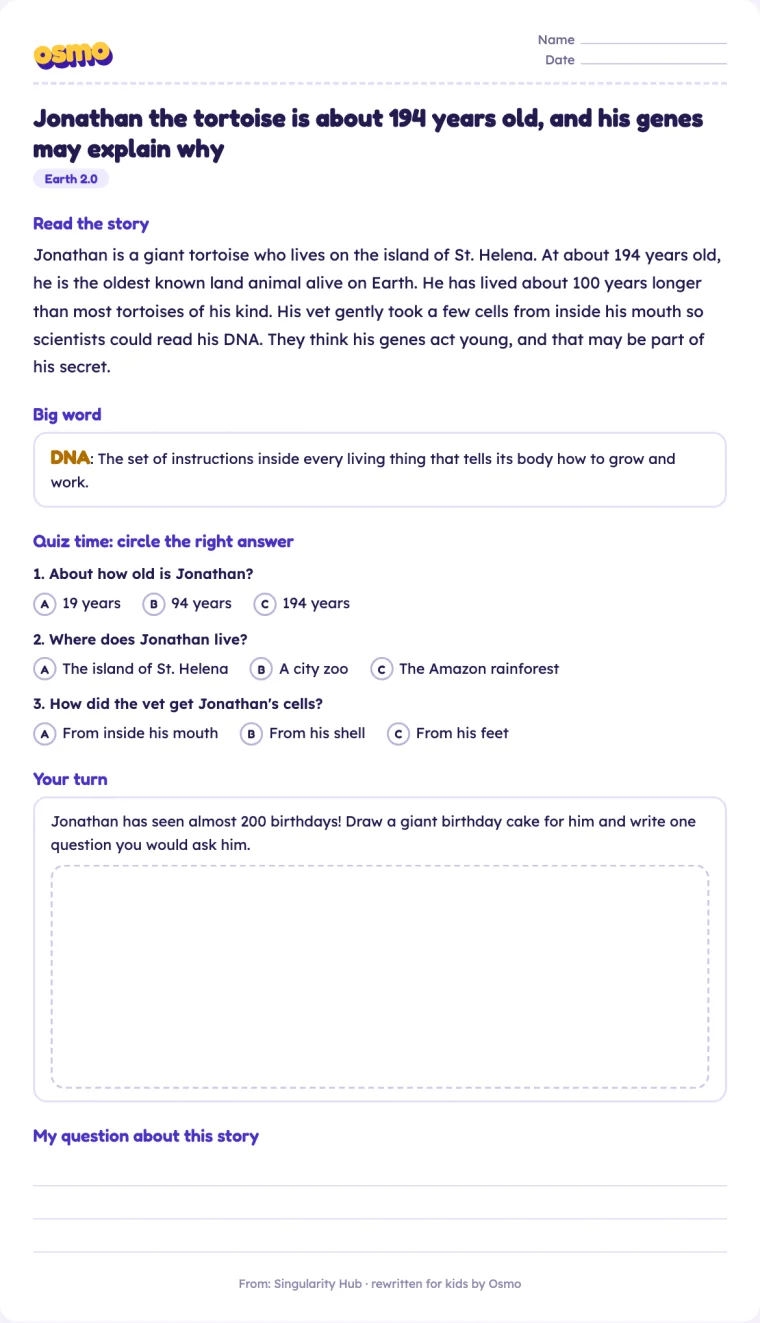
What it covers: Jonathan lives on St. Helena, has lived about 100 years longer than most tortoises of his kind, and his vet took cells from inside his mouth so scientists could read his DNA. "They think his genes act young, and that may be part of his secret." That word "may" is worth pointing out: scientists have a clue, not a final answer.
Download: osmo-worksheet-tortoise-grade3-5.pdf
Answer key: 1. C (194 years) 2. A (the island of St. Helena) 3. A (from inside his mouth)
4. Deep sleep and growing (Grades 3 to 5)
What it covers: during deep sleep the body sends out growth hormone, "a chemical messenger that helps build muscles and strong bones", and researchers at the University of California, Berkeley, found the brain cells in charge of releasing it. The big word is hormone.
Your turn: make a bedtime chart of the hour before sleep and circle one thing that helps you sleep deeply.
Download: osmo-worksheet-deep-sleep-grade3-5.pdf
Answer key: 1. A (muscles and bones) 2. A (during deep sleep) 3. A (University of California, Berkeley)
5. Saturn's moon Enceladus (Hindi, Grades 3 to 5)
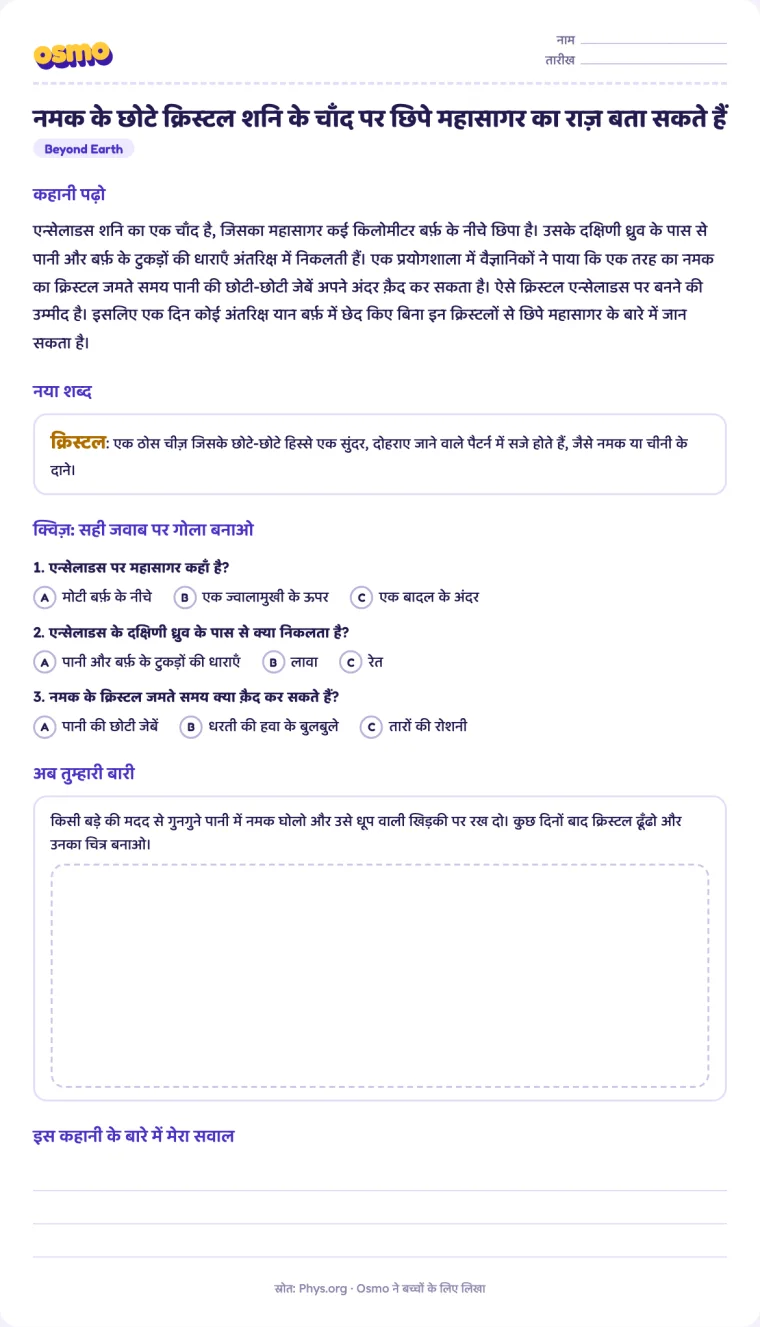
What it covers: Enceladus, a moon of Saturn, has an ocean hidden under kilometres of ice. Jets near its south pole spray water and icy bits into space, and a lab study found a kind of salt crystal can trap tiny pockets of water as it freezes. The whole sheet is in Hindi, so it works for Hindi-medium learners or as a bilingual science-and-language task. The big word is क्रिस्टल (crystal).
अब तुम्हारी बारी (Your turn): with a grown-up, dissolve salt in warm water, leave it on a sunny windowsill and draw the crystals that appear after a few days.
Download: osmo-worksheet-saturn-moon-hindi.pdf
Answer key: 1. A (मोटी बर्फ़ के नीचे, under thick ice) 2. A (पानी और बर्फ़ के टुकड़ों की धाराएँ, jets of water and icy bits) 3. A (पानी की छोटी जेबें, tiny pockets of water)
Worksheet for Grades 6 to 9 (Class 6 to 9)
6. Japan's Mars moon mission (Grades 6 to 9)
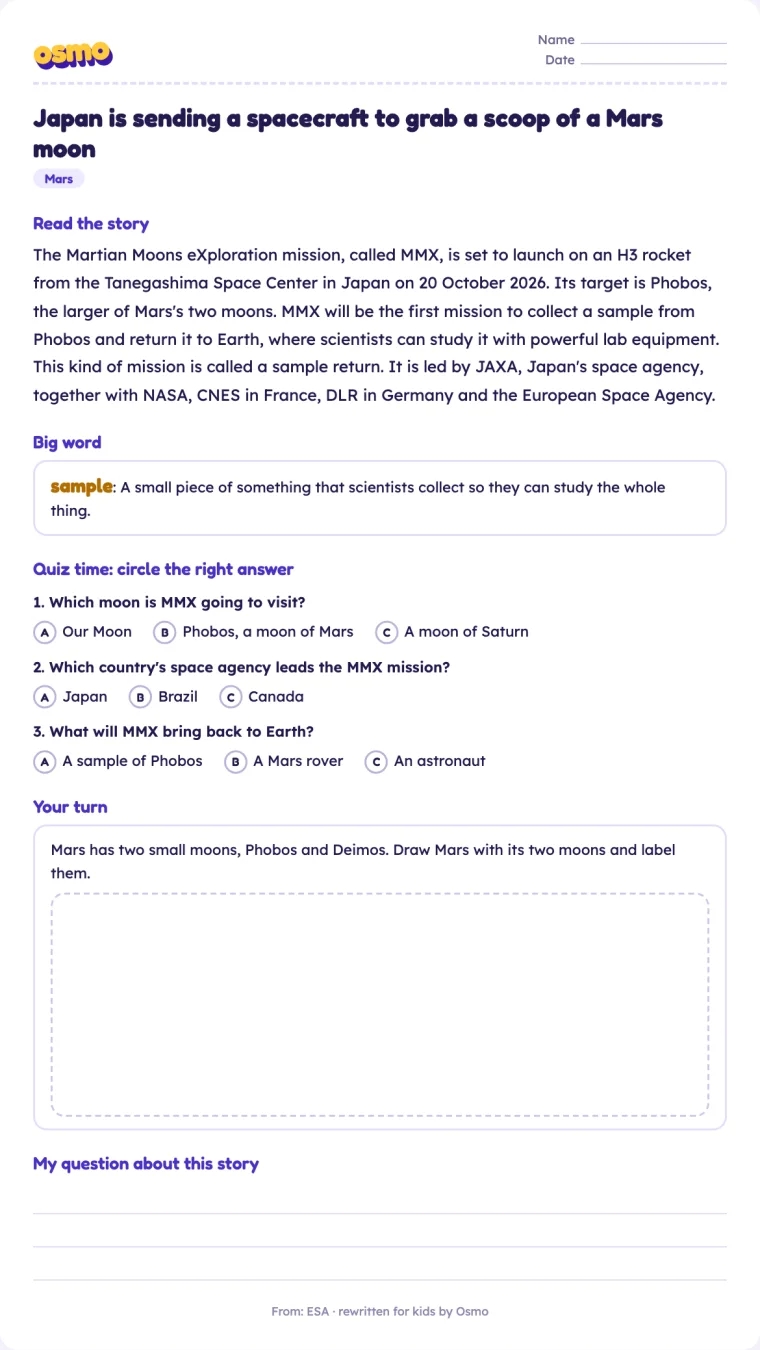
What it covers: the Martian Moons eXploration mission, MMX, led by Japan's space agency JAXA with NASA, CNES, DLR and ESA. It is set to launch on an H3 rocket from Tanegashima on 20 October 2026 (Japan time) to collect a sample of Phobos and bring it to Earth, the first mission of its kind. The big word is sample. ESA says the sample should reach Earth in 2031.
Your turn: draw Mars with its two moons, Phobos and Deimos, and label them.
Download: osmo-worksheet-mars-moon-grade6-9.pdf
Answer key: 1. B (Phobos, a moon of Mars) 2. A (Japan) 3. A (a sample of Phobos)
For more on this mission and what is in the night sky this month, see our guide to space news for kids.
Science worksheet for kids with answers: the quick key
| Worksheet | Q1 | Q2 | Q3 |
|---|---|---|---|
| Tortoise (K to 2 and Grades 3 to 5) | C | A | A |
| Baby walrus (K to 2) | B | A | A |
| Deep sleep (Grades 3 to 5) | A | A | A |
| Saturn's moon, Hindi (Grades 3 to 5) | A | A | A |
| Mars moon mission (Grades 6 to 9) | B | A | A |
How to use science worksheets for kids at home
Having printable science worksheets at home is a good start, but a worksheet on its own is just paper. A US Institute of Education Sciences reading guide makes this point directly: it says worksheets rarely teach what children should do in their heads to understand a text. The thinking comes from the talk around them. Here is a 15-minute routine that turns these PDFs into real learning.
- Predict (1 minute). Read only the title. "What do you think this is about?"
- Read (3 minutes). Younger children read with you or listen; older ones read alone, then read one sentence aloud to you.
- Big word (1 minute). Read the meaning together and ask your child to use the word in a sentence about their own life.
- Quiz (3 minutes). Circle the answers, then point to the proof in the story.
- Your turn (5 minutes or more). Do the activity. Let it get messy.
- My question (2 minutes). Your child writes or tells you one question the story did not answer. Look it up together later.
Why the quiz and the question? The IES guide on organising study rates using quizzes to re-expose students to key content, and asking deep explanatory questions such as "what caused this?" and "what if?", as supported by strong evidence. The same guide recommends spacing review over time, so bring the story back in a week or two: "Remember Jonathan? How old is he?"
Using these worksheets in class
- Differentiate with one story. Give the tortoise K to 2 sheet to emerging readers and the Grades 3 to 5 sheet to stronger ones. The class discusses the same story together.
- Science across subjects. The Hindi Saturn's moon sheet doubles as a Hindi reading task, and every sheet is a short non-fiction comprehension piece. Our guide to reading comprehension for Class 3, 4 and 5 has more passages and strategies.
- Question wall. Collect the "My question" boxes and pin them up. Pick one a week to investigate as a class.
- Source spotting. Ask older students to find the publisher named at the bottom of the sheet and open the original article.
Science activities for kids at home: extension ideas
| Worksheet | Extension activity |
|---|---|
| Tortoise | Make a family timeline: who is the oldest person you know, and how many years has Jonathan lived longer than them? |
| Baby walrus | Find Alaska on a map or globe. Measure roughly how far 800 miles is from your home to a city you know. |
| Deep sleep | Keep a one-week sleep diary: bedtime, wake time and how rested you feel. Look for a pattern together. |
| Saturn's moon | Grow salt crystals in two jars, one in a warm spot and one in a cool spot. Which grows faster? |
| Mars moon mission | Work out how old you will be when the sample comes back in 2031, then design your own sample-return mission. |
For more hands-on ideas, NASA Space Place has free crafts such as a CD Saturn, Oreo moon phases and a bubble-powered rocket. And if you are building a wider science habit at home, our guide to science news for kids lists trusted free sources by age.
Want a worksheet for every new story?
These six free science worksheets are a sample, and they will stay free to download. Osmo publishes a short daily edition of five science and technology stories, each rewritten by AI at three reading levels from a real publisher and approved by a person on our team before children see it. With Osmo Plus, an optional plan a parent buys through Google Play, every story comes with a printable worksheet in exactly this format: the story, the big word, the quiz and a hands-on "Your turn" activity. Plus also adds the full archive, stories in Hindi and a weekly bonus challenge.
In India, Osmo Plus costs ₹100 a month or ₹800 a year, with a 7-day free trial on the yearly plan; prices vary by country. The free version, with today's five stories, quizzes and read-aloud, stays free. You can see more on our worksheets page.
Download one sheet tonight, keep it to fifteen minutes and save the best question for the fridge.
Frequently asked questions
Are these science worksheets for kids free?
Yes. All six worksheets on this page are free PDFs you can download and print with no sign-up. They cover a giant tortoise, a Mars moon mission, Saturn's moon Enceladus, deep sleep and a baby walrus, at levels from K to Grade 9, with one in Hindi. Osmo Plus, an optional paid plan, adds a worksheet for every new Osmo story.
What grade are these science worksheets for?
There are three levels. The tortoise and baby walrus K to 2 sheets suit ages 5 to 7 (Class 1 to 2). The tortoise, deep sleep and Hindi Saturn's moon sheets suit Grades 3 to 5 (ages 8 to 10, Class 3 to 5). The Mars moon mission sheet is for Grades 6 to 9 (ages 11 to 14).
Do the worksheets come with answers?
The PDFs are designed for children, so the answers are not printed on them. The full answer key for every worksheet is on this page, under each worksheet. Each sheet has three multiple-choice questions, a big word with its meaning, a hands-on Your turn activity and a space for the child's own question.
How long does one science worksheet take?
About 10 to 15 minutes for most children: a few minutes to read the story, a few for the quiz and the rest for the Your turn activity. Some activities, like growing salt crystals, continue over a few days. Younger children can do the reading aloud with a grown-up and answer the quiz orally.
Can teachers use these worksheets in class?
Yes, they work well as a warm-up, a reading-across-subjects task or homework. The tortoise story comes at two levels, K to 2 and Grades 3 to 5, so a mixed class can read the same story at different depths. The Hindi worksheet suits Hindi-medium and bilingual classrooms.
Sources
- IES Practice Guide: Organizing Instruction and Study to Improve Student Learning (NCER 2007-2004)
- IES/WWC Practice Guide: Improving Reading Comprehension in Kindergarten Through 3rd Grade (NCEE 2010-4038)
- Singularity Hub: The oldest living land animal is 194
- ESA: Mars moon lander set to launch on 19 October
- JAXA press release: launch of MMX on H3 flight No. 10
- Phys.org: Salt crystals could hold clues to life beneath Enceladus's ice
- ScienceDaily: How deep sleep drives growth hormone release (UC Berkeley)
- Popular Science: Scientists rescue an orphaned walrus calf in Alaska
- NASA Space Place: Do (crafts and activities)
Written and fact-checked by the Osmo Editorial Team. Osmo is not affiliated with the apps, publishers or organisations mentioned. Spotted something out of date? Tell us.