Quick answer
The most reliable space news for kids comes straight from space agencies and from kids' publishers that rewrite their announcements. NASA Space Place, NASA Kids' Club, ESA Kids and ISRO's student pages are free. Pair one story with a real look at the night sky and a quick hands-on activity, and space stops being abstract.
- Ages 5 to 9: NASA Kids' Club, NASA Space Place, ESA Kids.
- Ages 9 to 14: Space Scoop, Science News Explores, agency news pages.
- India: ISRO's Students page, YUVIKA (after Class 9), National Space Day on 23 August.
- This month: a Mars moon sample mission and the Orionid meteor shower.
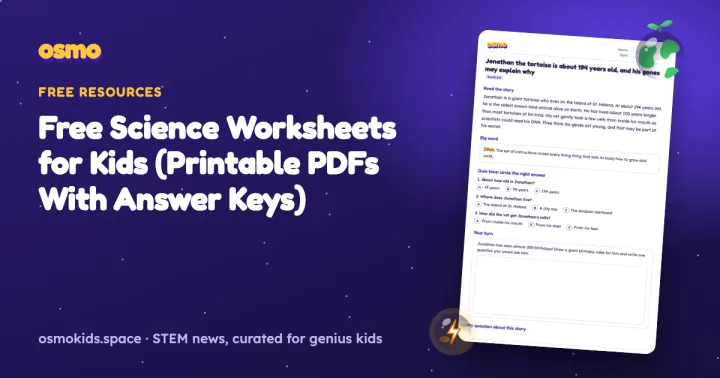
Want more? Our free worksheet library adds a printable STEM worksheet for every new science story we publish, sorted by class (K to Class 2, Class 3 to 5, Class 6 to 8), topic (including space) and language (Hindi), each with an answer key.
Children love space, but most space news is written for adults: rocket specifications, acronyms and dense mission timelines. Good space news for kids keeps the wonder and the facts and drops the jargon. This guide lists sources we have checked, explains three real recent stories at kid level, tells you what is in the sky this month and gives you activities that need nothing more than a window and a kitchen.
We make Osmo, a science news app for kids, and two of its ten topic "planets", Beyond Earth and Mars, are all about space. We quote real Osmo stories below as examples, but most of the sources here are free and not ours.
Space news for kids today: trusted free sources
| Source | Best for | What you get |
|---|---|---|
| NASA Space Place | Primary years | Explainers on the Sun, solar system and universe, games, crafts, a glossary, skywatching tips and a Spanish version. |
| NASA Kids' Club | Pre-K to Grade 4 | Games, a picture show of mission photos and "Now in Space", which introduces the astronauts on the International Space Station. |
| ESA Kids | Primary years | The European Space Agency's kids' site with Learn, News, Things to do and Games sections, in English, German, Spanish, French, Italian and Dutch. |
| Space Scoop | About 7 to 11 | Child-friendly versions of astronomy press releases, made by ESO with the Universe Awareness project. |
| Science News Explores | Middle school and up | Free science journalism from the non-profit Society for Science, including a space section. |
| ISRO Students page | Indian school students | YUVIKA, the ISRO STEM portal (courses, sessions with space scientists, a space quiz) and School Bhuvan, an NCERT map-based learning portal. |
| NASA Skywatching | Families together | A monthly "What's Up" sky guide, a daily Moon guide and meteor shower tips. |
Recent space news for kids: three real stories, explained
Here is what recent space news looks like when it is rewritten for children. These are real Osmo stories, quoted exactly, with the facts checked against the original sources.
1. Japan is sending a spacecraft to grab a scoop of a Mars moon
For ages 5 to 7, the Osmo story reads: "Mars has a little moon called Phobos. A spaceship called MMX will fly there. It will pick up some moon dust and bring it home to Earth."
For ages 8 to 10, it adds: "No mission has ever brought back a piece of a Mars moon before. Space agencies from Japan, the United States, France, Germany and Europe are working on it together."
The grown-up details, from JAXA and ESA: MMX is scheduled to launch on an H3 rocket from Tanegashima Space Center at 04:41 Japan time on 20 October 2026, which is the evening of 19 October in Europe. JAXA says the launch time may change during the reserved launch period. ESA says the spacecraft should reach Mars orbit in August 2027, release a small rover called Idefix in early 2029, collect at least 10 grams of Phobos in 2030 and return the sample to Earth in 2031. So a child in Class 4 today could be in Class 9 when the sample lands. That is a lovely way to make the timeline real.
2. Tiny salt crystals could tell us about a hidden ocean on Saturn's moon
The ages 8 to 10 version: "Enceladus is a moon of Saturn with an ocean hidden under kilometres of ice. Near its south pole, jets spray water and icy bits up into space. Scientists in a lab found that a kind of salt crystal can trap tiny pockets of water as it freezes."
This is a great story for teaching how careful scientists are. The original Phys.org article notes that this salt, called natron, has not yet been confirmed on Enceladus's surface. The kid version says such crystals "are expected to form" there. Ask your child: "What is the difference between 'expected' and 'found'?"
3. NASA's new space telescope is seeing even more sharply than planned
The ages 5 to 7 version: "NASA built a new telescope called Roman. Engineers moved its mirror just a teeny tiny bit. Now its pictures are even sharper than they hoped." For ages 8 to 10, the story adds that the mirror moved "just one-sixteenth the width of a human hair" and that the main camera now makes pictures "nearly 30% sharper than expected". ScienceDaily confirms both numbers and says the telescope is meant to study dark matter and dark energy.
Want more stories like these beyond space? Our guide to science news for kids covers trusted sources for every topic.
Astronomy news for kids: what is in the sky this month
Astronomy news for kids is best when it ends with "go and look". NASA's October 2026 "What's Up" guide lists these events:
| Date (2026) | Event | What NASA suggests |
|---|---|---|
| 4 October | Saturn at opposition | Saturn rises near sunset and stays up most of the night: one of the year's best chances to see it. |
| 6 October | Crescent Moon near Jupiter | A thin crescent Moon appears close to bright Jupiter before sunrise. |
| Night of 21 to 22 October | Orionid meteor shower peak | A bright Moon will wash out fainter meteors; the best chance may be a few hours before dawn, after the Moon sets. |
| Night of 27 to 28 October | Moon passes the Pleiades | Look east in the evening. The Pleiades look like a slightly fuzzy group of 6 to 7 stars; binoculars show more. |
NASA's guide is written from the United States, so times can differ where you live. The basics travel well: find the darkest spot you can, put phones away and give your eyes time to adjust. For India, a terrace or a trip out of the city lights makes a big difference.
Space news for kids in India: ISRO and beyond
Indian children have a special reason to follow space news. On 23 August 2023, the Vikram lander of Chandrayaan-3 touched down near the Moon's south polar region, and ISRO says this made India the fourth country to soft-land on the Moon and the first to reach that region. India now marks 23 August as National Space Day.
- YUVIKA: ISRO's Young Scientist Programme is a two-week residential programme for students who have passed Class 9. In 2026 it ran from 11 to 22 May across nine ISRO centres, including VSSC Thiruvananthapuram, SAC Ahmedabad and URSC Bengaluru. Watch the ISRO site early in the year for the next round.
- ISRO STEM portal: listed on ISRO's Students page, with online courses, video sessions with space scientists, a virtual museum, a space dictionary and a space quiz.
- SPARK virtual space museum: an online collection of documents, images and videos about ISRO's rockets, satellites and science missions.
- Global stories, Indian classrooms: the MMX story above fits neatly alongside school lessons on the solar system, and a night of meteor watching makes a ready-made observation diary.
Space activities for kids at home
Every Osmo worksheet ends with a "Your turn" activity. Here are the real ones from the three space stories above, plus free ideas from NASA Space Place.
- Draw Mars and its moons (from the MMX story): "Mars has two small moons, Phobos and Deimos. Draw Mars with its two moons and label them."
- Grow salt crystals (from the Enceladus story): "Ask a grown-up to help you dissolve salt in warm water and leave it on a sunny windowsill. In a few days, look for crystals and draw them."
- Be a telescope engineer (from the Roman story): "Hold a magnifying glass or a glass of water over a page. Move it a tiny bit. Draw how the words look when they are sharp and when they are blurry."
- NASA Space Place crafts: make a CD Saturn, Oreo moon phases or a bubble-powered rocket, all listed in the Space Place "Do" section.
- Count the Pleiades: on 27 to 28 October, ask everyone in the family how many stars they can see in the cluster, then check with binoculars.
Activities work because they make children do something with what they read. Research on learning backs this up: a US Institute of Education Sciences guide rates quizzing to re-expose students to key content, and asking "deep" questions such as "what caused this?" and "what if?", as supported by strong evidence. A drawing plus one "why" question is a small version of both.
Want a printable version? Our free science worksheets include a Grades 6 to 9 worksheet on the Mars moon mission and a Hindi worksheet on Saturn's moon, both with answer keys.
How to read space news articles for kids together
Space news articles for kids can raise big questions: how far, how long, could anyone live there? Here is a simple script.
- Size it: "If Earth were a football, how big would Phobos be?" Guessing is the point; look it up together afterwards.
- Time it: "MMX should bring its sample back in 2031. How old will you be?"
- Source it: "Which space agency told us this? Let's open their page."
- Sure or not sure: "Did scientists find this, or do they expect it?" (The Enceladus story is perfect for this.)
- Wonder: "If you could send a spacecraft anywhere, where would it go and what would it bring back?"
For younger children, keep it to one question and a drawing. If your child is curious about how scientists use computers and AI in space research, our guide on how to explain AI to kids may help.
Following space news with Osmo
In Osmo, space stories live on two of the ten topic planets: Beyond Earth and Mars. Each day's edition has five stories from real publishers such as NASA, ESA and Space.com, rewritten by AI at three reading levels using only facts from the original, and a person on our team approves every story before children see it. Each story credits and links its source, so you can always check the grown-up version.
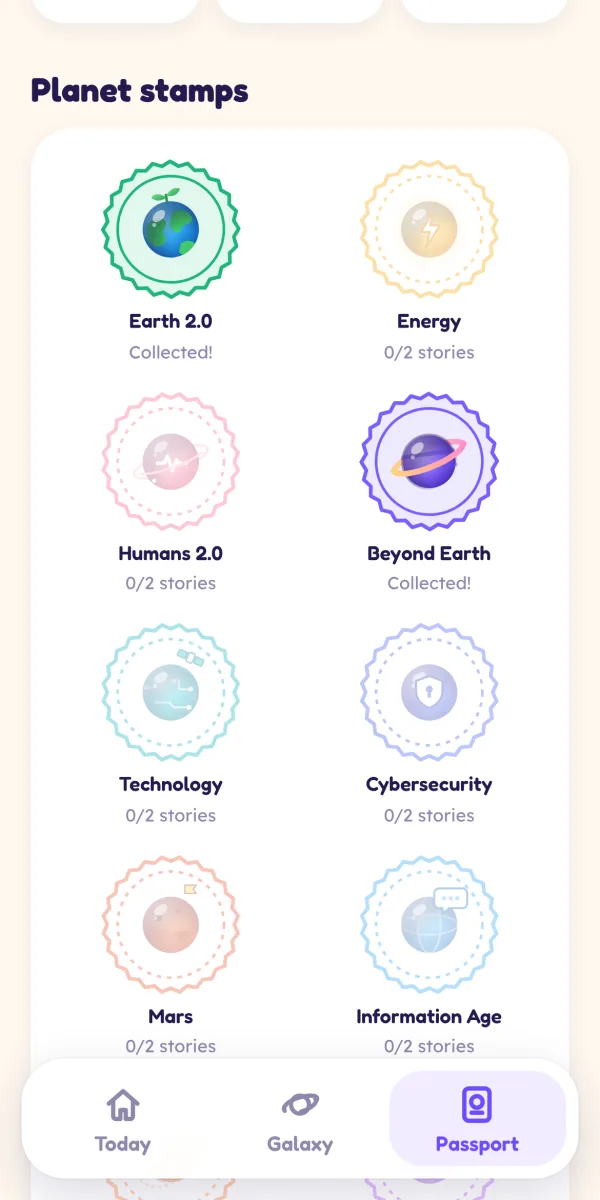
Children collect planet stamps and ranks in a passport as they read, and there are no streaks, on purpose. Osmo has no ads, no accounts and no chat between users. You can read more on our page for grown-ups.
Whatever you use, the formula for space news is the same: one real story, one look at the real sky and one thing to make or draw. Keep looking up.
Frequently asked questions
Where can kids find space news today?
NASA Space Place and NASA Kids' Club are free and written for young children. ESA Kids, the European Space Agency's site for children, is available in six languages, and ISRO's Students page lists programmes for Indian school children. For daily, dated stories, kids' news apps such as Osmo rewrite real space news from agencies like NASA and ESA at reading levels for ages 5 to 14.
What is the latest space news for kids in October 2026?
Japan's MMX spacecraft is scheduled to launch on 20 October 2026 (Japan time) to collect a sample from Phobos, a moon of Mars, and bring it to Earth. NASA's sky guide also lists the Orionid meteor shower peaking on the night of 21 to 22 October and the Moon passing the Pleiades on 27 to 28 October.
What is a good astronomy activity for kids at home?
Try a simple sky watch: on a clear night, find a dark spot, wait several minutes for your eyes to adjust and look for the Pleiades, a small fuzzy group of six or seven stars. NASA Space Place also has free crafts such as making a CD Saturn, Oreo moon phases and a bubble-powered rocket.
Does ISRO have resources for school children?
Yes. ISRO's Students page lists YUVIKA, a two-week residential Young Scientist Programme for students who have passed Class 9, and an ISRO STEM portal with courses, sessions with space scientists, a virtual museum and a space quiz. India also marks National Space Day on 23 August, the anniversary of the 2023 Moon landing.
How do I explain space news to a young child?
Start from what they can see or hold. Compare a moon sample to scooping sand into a jar, or a telescope mirror to a magnifying glass. Use one number at most, and finish with a drawing or a question. Asking a child to tell the story back to you is a simple retelling check, a strategy that reading research links to better comprehension.
Sources
- JAXA press release: launch of MMX on H3 flight No. 10
- ESA: Mars moon lander set to launch on 19 October
- Phys.org: Salt crystals could hold clues to life beneath Enceladus's ice
- ScienceDaily: NASA's Roman Space Telescope sharper than expected
- NASA: What's Up, October 2026 skywatching tips
- NASA Skywatching hub
- NASA Space Place
- NASA Space Place: Do (crafts and activities)
- NASA Kids' Club
- ESA Kids
- ESO announcement: Space Scoop, astronomy news for children
- ISRO: Students
- ISRO: YUVIKA 2026
- ISRO: National Space Day 2026
- ISRO: Chandrayaan-3 details
- IES/WWC Practice Guide: Improving Reading Comprehension in Kindergarten Through 3rd Grade (NCEE 2010-4038)
- ISRO: Virtual Space Museum (SPARK)
- Science News Explores (Society for Science)
- IES Practice Guide: Organizing Instruction and Study to Improve Student Learning (NCER 2007-2004)
Written and fact-checked by the Osmo Editorial Team. Osmo is not affiliated with the apps, publishers or organisations mentioned. Spotted something out of date? Tell us.