Quick answer
How to raise a curious child? Treat questions as the main event: answer with real explanations, admit what you don't know, and investigate together. Research links curiosity to better memory and early school achievement. Small daily habits work better than expensive classes.
- Give real "because" answers. Children keep asking when they get a non-answer.
- Say "I don't know, let's find out" often. It is a powerful sentence.
- Show less, ask more: over-teaching can shrink exploration.
- Build a daily "curiosity diet": one surprising fact, one big question, one thing to try.
- Praise questions, not just correct answers.
If you are wondering how to raise a curious child, you are already doing the first thing right: paying attention. Curiosity is not a fixed trait some children have and others lack. It is a habit that adults either feed or starve, often without noticing.
This guide pulls together what researchers have actually found about curiosity in children, then turns it into things you can do tonight: an age-by-age playbook, word-for-word scripts for the hundredth "why?", a simple daily routine and the mistakes that quietly kill wonder.
What research says about curiosity in children
A lot of parenting advice on curiosity is opinion. Here is what the studies show, and what they don't.
Young children ask a huge number of questions
Psychologist Michelle Chouinard tallied every question in home transcripts of four preschool children. Their information-seeking questions came at an average of 76 per hour, as summarised in a later paper in Child Development. That is more than one a minute. Questions are how young children build their picture of the world.
Children can tell a real answer from a brush-off
In a 2009 study, Brandy Frazier, Susan Gelman and Henry Wellman looked at what preschoolers did after asking "why" and "how" questions. In a lab experiment with 42 children aged 3 to 5, children re-asked their question 21.4% of the time after a non-explanation, compared with just 1.2% after a real explanation. After a genuine answer, they were far more likely to agree or ask a follow-up. In other words, "because I said so" does not end the question. It just postpones it.
Curiosity helps memory
A 2014 brain-imaging study in Neuron by Matthias Gruber, Bernard Gelman and Charan Ranganath asked adults trivia questions. People remembered answers better when they were curious about them, and they even remembered unrelated faces shown to them while they were curious. The study was with adults, not children, but it fits what parents see: a child who wants to know remembers.
Curiosity is linked to early school success
A 2018 study in Pediatric Research led by Prachi Shah at the University of Michigan used data on about 6,200 US children. Children rated as more curious had higher reading and maths scores at kindergarten, and the link was stronger for children from low-income families. The authors are careful: this shows an association, not proof that curiosity causes achievement.
Too much teaching can shrink exploration
In a 2011 MIT-led study with 85 preschoolers at Boston's Museum of Science, children were given a toy with four hidden functions. When an adult deliberately taught them one function, many children found nothing else. Children who were not taught that way discovered more and played longer. Co-author Laura Schulz's advice was simple: tell children there are other possibilities to consider.
School often runs on answers, not questions
Developmental psychologist Susan Engel has argued in the Harvard Educational Review that curiosity is central to learning but largely missing from classrooms. Writing in Education Week, Alfie Kohn quotes her description of the schools she observed: "an astonishingly low rate of curiosity in any of the classrooms we visited." That makes home the place where curiosity is most easily protected.
Researchers still disagree on exactly how to define curiosity. In a 2015 review in Neuron, Celeste Kidd and Benjamin Hayden settled on a practical description: a drive state for information, a bit like hunger, but for knowing.
How to raise a curious child: five principles
- Answer with real explanations. Short is fine, but give a "because". "Leaves are green because they contain a green substance that catches sunlight to make food" beats "that's just how it is".
- Turn some questions back. Not every one, or it feels like a quiz. Try "What do you think?" about one in three times.
- Admit what you don't know. Then show how to find out: a book, a reliable website, an experiment, or asking an expert.
- Leave things open. After explaining, add "and scientists are still figuring out..." or "there are other things this can do. Can you find them?"
- Make wondering visible. Think aloud: "I wonder why the moon looks bigger near the horizon." Children copy what you do more than what you say.
Age-by-age playbook: how to encourage curiosity in kids
| Age | What curiosity looks like | What helps most | Try this |
|---|---|---|---|
| 2 to 4 | Touching, tasting, "what's that?", endless "why?" | Safe things to explore, names for everything, patient real answers | A "mystery bag": feel an object without looking and guess what it is |
| 5 to 7 (Class 1 to 2, K to Grade 2) | Big questions about animals, space, bodies, "where did I come from?" | Picture books, short true stories, simple experiments | Float or sink: predict first, then test ten household objects |
| 8 to 10 (Class 3 to 5, Grades 3 to 5) | Collecting facts, records, "what's the biggest...?" | Asking "how do we know?", letting them become the family expert on a topic | A weekly "fact of the week" they teach to the family at dinner |
| 11 to 14 (Class 6 to 9, Grades 6 to 9) | Fewer questions out loud, deeper interest in ideas, fairness, the future | Respect, real-world problems, debate, being treated as a thinker | Read one real science news story and argue about whether it matters |
A useful pattern across all ages: the older the child, the more they need to feel their question is taken seriously. Tweens often stop asking aloud because they don't want to look silly. Ask for their opinion first, and the questions come back.
Scripts for the hundredth "why?"
When you are tired, these ready-made lines help you keep the door open without a lecture.
- When you know the answer: "Great question. The short answer is... Want the longer version?"
- When you don't: "I don't know! What's your guess? Let's check after dinner."
- When you can't talk right now: "That's a good one. Put it in the question jar and we'll pick it tonight." (Then actually do it.)
- To stretch thinking: "What would happen if...?" or "How could we test that?"
- To build evidence habits: "How do we know that's true? Who found it out?"
- To keep it open: "That's what we know so far. Scientists are still working out the rest."
- For a tricky topic: "That's a big question. What made you think of it?" This tells you what they really want to know before you answer.
Notice that none of these scripts require you to be an expert. Curious children don't need parents who know everything. They need parents who enjoy finding out.
The daily "curiosity diet": a 20-minute routine
Think of curiosity like nutrition: small, regular servings beat one big feast. Here is a routine that fits around school, homework and tuition.
| When | Serving | Time |
|---|---|---|
| Morning or school run | One surprising true fact or short science story | 5 minutes |
| After school | One "notice" challenge: three things that changed outside today | 3 minutes |
| Dinner | One big question from the question jar, everyone guesses before anyone checks | 7 minutes |
| Bedtime | One "big word" learned today, used in a silly sentence | 2 minutes |
| Weekend | One "let's find out" project: an experiment, a museum, a nature walk | 30 to 60 minutes |
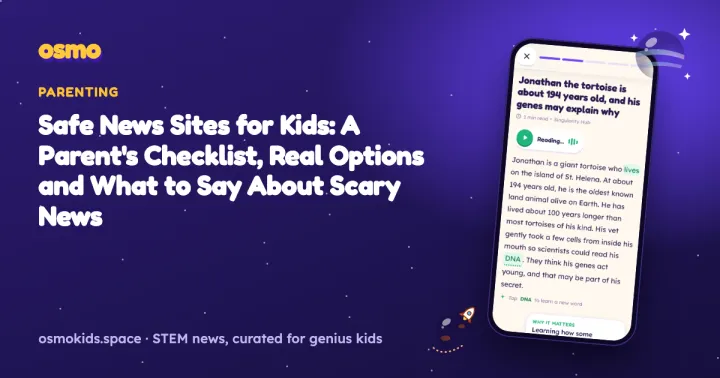
The morning serving is where a short, finishable news habit fits. Real science news is full of open questions, which is exactly what curiosity feeds on. Take this real story about Jonathan the giant tortoise, written for children aged 5 to 7: "Jonathan is a giant tortoise. He is about 194 years old! Scientists studied his body to learn why he has lived so long." That last sentence opens a gap: why has he lived so long? Your child will want to know.
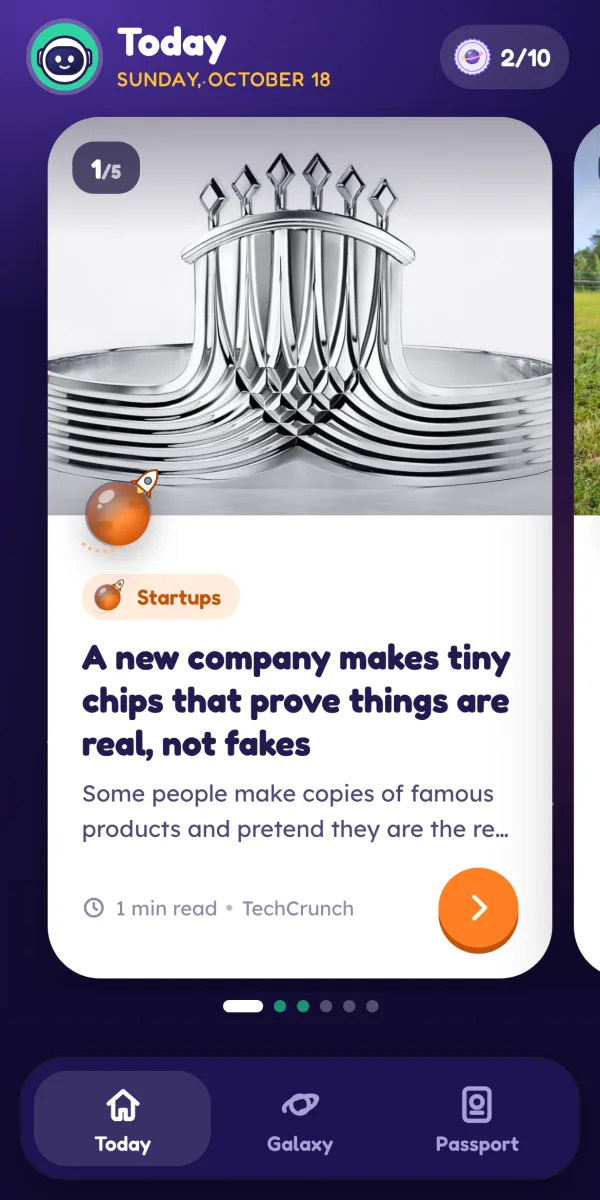
This is the idea behind Osmo, our app (so we are biased). It gives children five short science and technology stories a day from publishers like NASA and ScienceDaily, written at three reading levels, each with a "why it matters" line and one big word to learn. There is no endless feed, so it ends when the edition ends. If you prefer paper, our free tortoise worksheet for Grades 3 to 5 works well as a dinner-table starter.
How to make your child curious when they seem uninterested
Some children seem to have no questions at all. Usually the curiosity is there, pointed at something adults don't value: football statistics, a video game, slime, cricket scores, a K-pop band. Start there.
- Follow the existing interest. A gaming child can wonder how games are designed, why some levels feel addictive, or how a computer draws 3D worlds.
- Lower the stakes. If questions at school get marked right or wrong, home questions should feel safe and even silly.
- Use mysteries, not lessons. "There's a shrimp that can see a kind of light we can't. What do you think it sees?" beats "Today we'll learn about colour vision."
- Give them the expert role. Children who teach something to a parent get curious about the parts they can't yet explain.
- Check the basics. Tired, hungry, anxious or over-scheduled children have little energy for wondering. Sometimes the fix is free time, not more activities.
Mistakes that quietly kill curiosity
- Brush-off answers. "Because I said so" and "you'll learn it later" teach children that questions are a nuisance.
- Over-teaching. As the toy study showed, showing exactly how something works can stop children exploring further. Demonstrate less, then step back.
- Only praising right answers. Praise good questions too: "That's such an interesting thing to wonder about."
- Turning every question into a lesson. If each "why?" triggers a 15-minute lecture, children learn to stop asking.
- Filling every minute. Boredom is often where curiosity starts. A child with nothing scheduled will eventually poke at something.
- Endless feeds instead of finishable content. Autoplay and infinite scroll hand children a stream of answers to questions they never asked. Prefer things with an end. Our guide to educational screen time for kids goes deeper.
- Chasing "smarter" instead of "interested". Many parents type "how to make child smarter" into a search bar. No routine guarantees that, and curiosity is not a hack for IQ. But a child who loves finding things out will keep learning long after any class ends.
Curiosity, exams and the Indian classroom
Many Indian parents worry that curiosity is a luxury next to board exams and entrance tests. Policy is moving the other way. A December 2025 government overview of NEP 2020 describes its focus as "shifting away from rote learning to an enquiry-based education", and Atal Tinkering Labs, now in about 10,000 schools for Classes 6 to 12, aim at "fostering curiosity, creativity, imagination" through hands-on making.
You do not need to choose between curiosity and marks. Asking "why does this formula work?" or "where would we see this in real life?" makes revision stick better, because, as the memory study suggests, we hold on to what we are curious about. For more ideas on keeping up with the world, see our guide to science news for kids.
Start this week: a simple checklist
- Put a "question jar" on the dinner table and pull one question a night.
- Say "I don't know, let's find out" at least once a day.
- Read one short true science story with your child each morning.
- Ask "how do we know?" about one claim this week, from an ad, a video or a news headline.
- Plan one weekend "let's find out" mini-project, chosen by your child.
- Notice and praise one great question your child asks.
So, how to raise a curious child in one line? It is less about clever activities and more about a household attitude: questions are welcome, not knowing is fine, and finding out is fun. Keep the servings small and regular, and curiosity tends to look after itself.
Frequently asked questions
At what age are children most curious?
Curiosity shows up from infancy, but the preschool years are famous for questions. In home recordings analysed by psychologist Michelle Chouinard, young children asked information-seeking questions at an average of about 76 per hour. Curiosity does not have to fade after that. What changes is whether adults keep rewarding questions, so the habits you build from about 3 to 10 matter a lot.
How do I encourage curiosity in kids who only want screens?
Do not fight the interest, follow it. Ask how the game or video works, who made it and why it is designed to keep you watching. Then offer short, finishable alternatives: a five-minute science story, a question jar at dinner, a walk with a 'notice three things' challenge. Curiosity grows from small daily wins, not from long lectures about screen time.
Does curiosity make a child smarter?
No study shows curiosity raises IQ, so be wary of anyone promising that. What research does show is that curiosity is linked to learning. A 2018 study of about 6,200 US children found more curious children had higher kindergarten reading and maths scores, and a 2014 brain study found people remember information better when they are curious about it.
What should I say when I don't know the answer to my child's question?
Say so, happily: 'I don't know. What do you think? How could we find out?' Then look it up together, or try a small experiment. This teaches that not knowing is the start of learning, not something to hide. It also models how to check a source, which matters more every year as children meet AI answers and online claims.
How can I raise a curious child in a busy Indian household with exams and tuition?
Keep it small and daily rather than adding another class. Ten minutes at dinner for one 'big question', one short science story on the way to school, and one weekend 'let's find out' project is enough. NEP 2020 itself calls for moving away from rote learning toward inquiry, so curiosity at home supports what schools are being asked to do.
Sources
- Frazier, Gelman and Wellman (2009), Preschoolers' Search for Explanatory Information Within Adult-Child Conversation, Child Development (PMC)
- Gruber, Gelman and Ranganath (2014), States of Curiosity Modulate Hippocampus-Dependent Learning via the Dopaminergic Circuit, Neuron (PMC)
- ScienceDaily: Curiosity may be key to early academic success (Shah et al., Pediatric Research, 2018)
- ScienceDaily: Teaching limits exploration (Bonawitz et al., Cognition, 2011)
- Loewenstein (1994), The Psychology of Curiosity: A Review and Reinterpretation, Psychological Bulletin
- Kidd and Hayden (2015), The Psychology and Neuroscience of Curiosity, Neuron (PMC)
- Alfie Kohn, Education Week (2024): All Learning, No Questioning: How Schools Smother Curiosity
- Susan Engel (2011), Children's Need to Know: Curiosity in Schools, Harvard Educational Review
- Singularity Hub (2026): The oldest living land animal is 194. Now his DNA may reveal secrets to longevity
- Phys.org (2026): Red-sensitive pigments in mantis shrimp eyes
- PIB (December 2025): From Classrooms to Creation Labs, school-level innovation under NEP 2020
Written and fact-checked by the Osmo Editorial Team. Osmo is not affiliated with the apps, publishers or organisations mentioned. Spotted something out of date? Tell us.