Quick answer
How to teach kids entrepreneurship: train them to notice problems, invent small fixes, and test those fixes on real people. Start with games at 5, run a supervised mini-business at 8 to 10, and add pricing, records and pitching at 11 to 14. Profit matters less than the habit of solving problems.
- Begin with problems, not products: "what annoys people?"
- Run one tiny, supervised business and do the maths together.
- Teach revenue, cost, profit and save-spend-share with their own money.
- Use the news: real startups show how ideas start from everyday problems.
- Keep it safe: adults handle money, online accounts and anything involving strangers.
Most parents who look up how to teach kids entrepreneurship are not hoping for a ten-year-old CEO. They want a child who sees a problem and thinks "I could fix that", who can talk to people, handle a little money and bounce back when something flops. Those skills are useful whether your child ends up running a startup, a hospital ward or a research lab.
This guide gives you a by-age plan, real kids business ideas with safety notes, the money basics to teach along the way, and a weekly exercise that uses real startup stories to train problem-spotting.
What entrepreneurship means for a child
Strip away the jargon and entrepreneurship is a loop with four steps. Teach your child these words and use them often.
- Problem: something that is slow, annoying, expensive or missing for somebody.
- Idea: a possible fix.
- Customer: a real person who has the problem and might want the fix.
- Value: what the customer gets, and what they will give back (money, time, a thank-you).
The loop then repeats: try, listen, improve. That "listen and improve" step is where the real learning happens, so a business that flops on the first day is not a failure. It is the lesson.
How to teach kids entrepreneurship, age by age
| Age | Focus | Activities |
|---|---|---|
| 5 to 7 (Class 1 to 2, K to Grade 2) | Noticing problems, making things for others, "things cost money" | Play shop with real coins; a "problem hunt" around the house; make a gift for someone and ask what they liked |
| 8 to 10 (Class 3 to 5, Grades 3 to 5) | A first real mini-business with adult support | Plan, price and run one stall or service; count costs and profit together; write a thank-you note to each customer |
| 11 to 14 (Class 6 to 9, Grades 6 to 9) | Customers, pricing, simple records, pitching | Interview five potential customers before building; keep a simple income and cost sheet; pitch the idea to family in two minutes; enter a school innovation challenge |
A script to get started at any age
Try this at dinner: "Tell me one thing that annoyed you today. Who else has that problem? What could fix it? Would anyone pay for the fix, or would they just say thank you?" Ask it once a week and you have the core of how to teach your child to be an entrepreneur, without buying anything.
Money basics every young entrepreneur needs
Money habits start early. A 2013 review by University of Cambridge researchers David Whitebread and Sue Bingham, for the UK's Money Advice Service, concluded that money habits are typically formed early in childhood. The US Consumer Financial Protection Bureau's free "Money as You Grow" pages suggest age-appropriate money conversations and activities you can use alongside a mini-business.
Teach these five ideas, with real numbers from your child's own project.
- Revenue: all the money that comes in.
- Costs: everything you spent to make or sell the product, including the bits you forget, like cups, tape and the bus fare.
- Profit: revenue minus costs. It can be negative, and that is useful to see.
- Price: what customers pay for one item. Too high and nobody buys; too low and you lose money.
- Save, spend, share: decide in advance how the profit will be split.
A worked example (example numbers)
| Item | India: nimbu pani stall | US: lemonade stand |
|---|---|---|
| Ingredients and cups | ₹200 | $15 |
| Price per cup | ₹20 | $1 |
| Cups sold | 18 | 25 |
| Revenue | ₹360 | $25 |
| Profit | ₹160 | $10 |
Then ask: how many cups did we need to sell just to cover our costs? (Ten in India, fifteen in the US.) What would happen if we charged a little more? That one question teaches more about pricing than a chapter in a textbook.
Kids business ideas, with supervision notes
The best kids business ideas are cheap to start, solve a real problem for people you know, and can be done safely with an adult nearby. Here are ideas grouped by age.
| Idea | Best age | Problem it solves | Supervision note |
|---|---|---|---|
| Handmade cards, bookmarks or rakhis | 6+ | Personal gifts for festivals and birthdays | Sell to family and neighbours; adult holds the cash box |
| Plant watering while neighbours travel | 8+ | Plants dying during holidays | Only for people you know; adult agrees the arrangement |
| Pet feeding or walking | 9+ | Busy owners | Familiar, calm pets only; adult accompanies walks |
| Bike or car wash | 9+ | Dirty vehicles, no time | On your own driveway or society parking; adult present |
| Craft or snack stall at a school fair | 8+ | Fun things to buy at the fair | Follow the school's rules; ask before selling food |
| Teaching a younger child a skill (chess, drawing, a sport) | 11+ | Parents looking for help | In your home or theirs with a parent present |
| Photo or video help for family events | 12+ | Nobody has time to film everything | Family and friends only; agree on privacy first |
| Recycled-material products (planters, organisers) | 10+ | Waste plus a need for cheap storage | Adult handles cutting tools and glue guns |
Kids business ideas for a 10 year old
Ten is a sweet spot: old enough to plan and count, young enough to need help. For a 10 year old, pick one idea from the list above that uses a skill they already have, aim for a single event or a one-week trial, and keep the customers to people you know. Afterwards, ask three questions: what went well, what would you change, and would you do it again?
The "spot the problem" news exercise
Entrepreneur kids are, above all, good problem-spotters. A fun way to train that is to read real stories about young companies and ask what problem each one noticed. Here are two real stories from Osmo's Startups planet, exactly as children aged 8 to 10 read them.
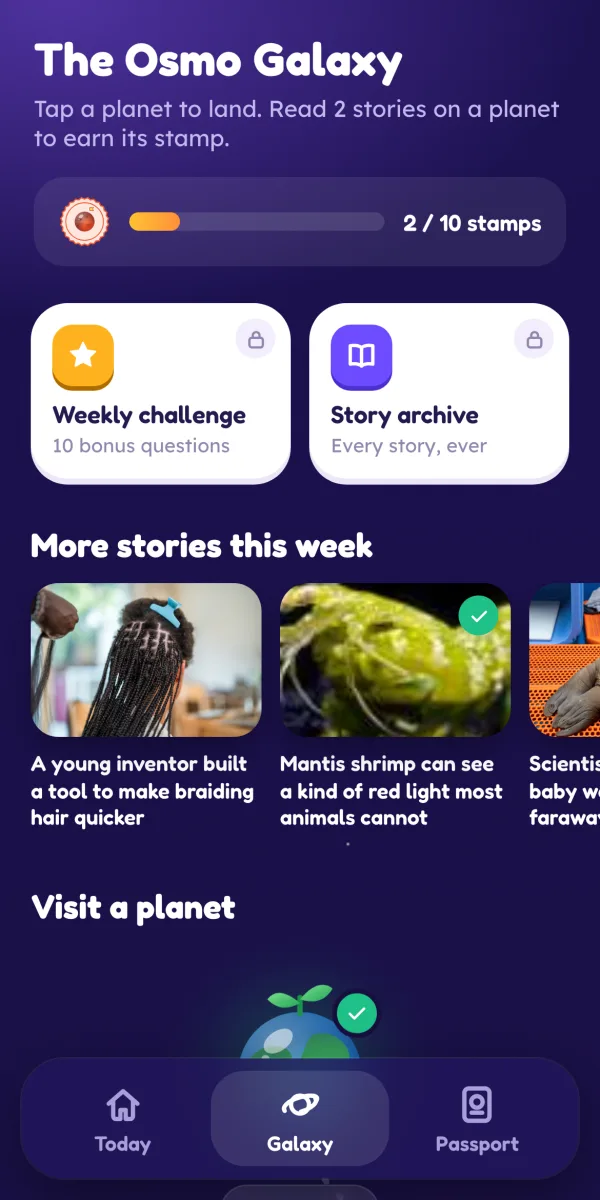
"Aisata Diallo has been braiding hair all her life. In college, she started braiding other people's hair too. A single braided style can take eight hours! Aisata noticed which parts of the job were slow and tiring. So she started a company called Tressfecta. Its first tool, called Plait Pilot, helps braiders separate hair before they begin braiding."
"Some people make copies of famous products and pretend they are the real thing. A startup called Veritas has made a small chip that can be tucked inside a product without damaging it. Brands can use the chip to check whether an item is genuine."
Now run the exercise. It takes ten minutes.
- Find the problem. What was slow, annoying or unfair? (Braiding takes hours; fakes trick people.)
- Find the customer. Who has that problem? (Hair braiders; brands and the people who buy their products.)
- Find the clue. How did the founder notice it? Aisata noticed because she did the job herself.
- Your turn. What job in your house or school takes too long? Draw an invention to make it quicker, and give your company a name.
That last step is the actual activity printed with the braiding story in Osmo. Osmo is our app: it gives children five short science and technology stories a day, and its Startups planet collects stories about young companies and big ideas. Each story has a "why it matters" line, a big word (for the braiding story, it is "startup") and a three-question quiz.
Safety, legality and supervision
- An adult knows where your child is, who the customers are, and agrees every arrangement.
- No going into strangers' homes or cars, and no meeting customers alone.
- Money is counted and stored by or with an adult.
- Online selling or social media accounts are run in an adult's name, following the platform's own age rules.
- Selling food, or selling regularly, may need permission. Rules differ by city, state and country, so check before you start.
Rules really do vary. In the US, Texas passed a law in 2019 so that children can run occasional stands selling lemonade and other non-alcoholic drinks on private property without a permit. Other places have different rules, so a quick check with your housing society, school or local office is worth it.
Programmes in India and the US
India
- Atal Tinkering Labs (ATL): makerspaces in schools for Classes 6 to 12, set up under the Atal Innovation Mission. A December 2025 government overview says there were 10,000 ATLs as of October 2025, with tools such as DIY electronics kits, 3D printers and sensors, and a goal of promoting "a culture of innovation and entrepreneurship". Students can take part in the annual ATL Marathon, a national innovation challenge.
- School Innovation Council (SIC): launched in 2022 by the Ministry of Education's Innovation Cell with AICTE and CBSE. Its activities include field visits for problem identification, workshops on business model development and demo days for prototypes. Ask your school whether it has registered.
United States
- Lemonade Day: a programme that teaches young people "how to start, own and operate their very own business" through a lemonade stand, run in participating communities.
- Junior Achievement: JA BizTown (Grades 4 to 5) combines classroom lessons with a day in a simulated town where students run banks and restaurants. JA More Than Money (Grades 3 to 5) covers money and starting a business, and JA Company Program (Grades 9 to 12) has students launch a venture that solves a community problem.
How to teach kids business without taking over: mistakes to avoid
- Doing it for them. If you make the product, set the price and talk to customers, it is your business. Let them make the decisions, even imperfect ones.
- Focusing only on money. Praise noticing problems, asking good questions and being kind to customers as much as profit.
- Rescuing every flop. Ask "what would you change next time?" instead of fixing it.
- Going too big. One afternoon stall teaches more than a grand plan that never launches.
- Skipping the numbers. Always do the revenue, cost and profit sum together, even if it is three lines on a scrap of paper.
- Forgetting curiosity. Entrepreneurs are curious people. Our guide on how to raise a curious child pairs well with this one, and so does our look at the skills kids need in the age of AI.
Your plan for this week
- Monday: ask the "one thing that annoyed you" question at dinner.
- Wednesday: read one real startup story together and do the four-step "spot the problem" exercise.
- Friday: choose one tiny business idea and list its costs.
- Weekend: run it for an hour, then count revenue, costs and profit together.
That is really how to teach kids entrepreneurship: small loops of noticing, trying and improving, with you beside them. Some children will catch the bug and keep going. All of them will learn that problems are things you can do something about. For more ways to connect children with real-world ideas, see our guide to current affairs for kids.
Frequently asked questions
What age should kids start learning entrepreneurship?
You can start the mindset at about 5 with simple ideas: noticing problems, making things for others, and understanding that things cost money. Real mini-businesses with a few customers suit most children from about 8 to 10, with an adult involved. From 11 to 14, children can handle pricing, simple records, marketing and school innovation challenges. Go at your child's pace.
What are good kids business ideas for a 10 year old?
Good options for a 10 year old are low-cost, low-risk and supervised: handmade cards or bookmarks, a plant-sitting or pet-feeding service for neighbours, a car or bike wash, a small craft stall at a school fair, or tutoring younger children in a skill they are good at. Keep sales to people you know and keep an adult in charge of money and safety.
Is it legal for kids to run a business?
It depends on where you live and what they sell. Small one-off sales to family and neighbours are usually informal, but selling food, selling online or running something regularly can bring rules on permits, food safety and platform age limits. Texas, for example, passed a 2019 law protecting children's occasional lemonade stands. Check local rules, and keep any account in an adult's name.
How do I teach my child about money and profit?
Use a real mini-business. Before they sell anything, sit down and list every cost, set a price, and work out how many sales they need to cover costs. Afterwards, count the money together: revenue minus costs equals profit. Then decide together how much to save, spend and share. Doing the maths with their own coins teaches more than any worksheet.
Are there entrepreneurship programmes for school students in India?
Yes. Atal Tinkering Labs, set up under the Atal Innovation Mission, give students in Classes 6 to 12 hands-on makerspaces, and the ATL Marathon is a national innovation challenge. The Ministry of Education's Innovation Cell also runs School Innovation Councils with CBSE and AICTE, which include problem-finding field visits, business model workshops and demo days.
Sources
- PIB (December 2025): From Classrooms to Creation Labs, school-level innovations under NEP 2020 (Atal Tinkering Labs, School Innovation Council)
- Junior Achievement USA: Programs (JA BizTown, JA More Than Money, JA Company Program)
- Lemonade Day: official site
- Romper (2019): Kids can legally sell lemonade in Texas thanks to a new law
- MPR News (2013): How to talk to your kids about money (Cambridge study by Whitebread and Bingham)
- Consumer Financial Protection Bureau: Money as You Grow
- TechCrunch (2026): Tressfecta wants to make hair braiding a less arduous task for hairstylists
- TechCrunch (2026): Veritas is building a chip to verify luxury goods
Written and fact-checked by the Osmo Editorial Team. Osmo is not affiliated with the apps, publishers or organisations mentioned. Spotted something out of date? Tell us.