Quick answer
The skills kids need in the age of AI are the ones AI can't do for them: thinking critically, staying curious, communicating, creating, bouncing back, and understanding AI itself. Global frameworks from the WEF, UNESCO and OECD, and India's NEP 2020, agree. You build them at home with small daily habits, not expensive courses.
- Critical thinking: make "How do we know?" a family habit.
- Curiosity: one surprising true story a day.
- Communication: explain-it-back at dinner.
- Creativity: make something with no instructions every week.
- AI literacy and resilience: talk about AI's mistakes, and your own.
Every parent is asking some version of the same question: what are the skills kids need in the age of AI, when a chatbot can write an essay in seconds? The honest answer is reassuring. The skills that matter most are deeply human, and you can practise them at the kitchen table.
Below we pull together what the major frameworks actually say, with exact sources, and turn it into concrete practices for ages 5 to 14, plus a weekly plan.
What the global frameworks actually say
World Economic Forum: Future of Jobs Report 2025
The WEF surveyed over 1,000 employers representing more than 14 million workers across 55 economies. Its findings are the clearest signal of where work is going.
- Workers can expect about 39% of their existing skill sets to be transformed or become outdated over 2025 to 2030.
- The top core skills in 2025, by the share of employers who see them as core: analytical thinking (69%), resilience, flexibility and agility (67%), leadership and social influence (61%), creative thinking (57%). Curiosity and lifelong learning sits at 50%.
- AI and big data are the fastest-growing skills, followed by networks and cybersecurity and technological literacy. Creative thinking, resilience, and curiosity and lifelong learning are also expected to rise in importance.
- The report projects 170 million jobs created and 92 million displaced by 2030.
Note the mix: technical skills are rising, but so are the human ones. That is the core message for parents.
UNESCO: AI competency framework for students (2024)
UNESCO's framework sets out 12 competencies across four dimensions: a human-centred mindset, ethics of AI, AI techniques and applications, and AI system design. Children progress through three levels: understand, apply and create. Notice that two of the four dimensions are about values and judgement, not technology.
OECD and the European Commission: the AILit Framework (2026)
In June 2026 the European Commission and the OECD presented an AI Literacy Framework for primary and secondary education. It describes how learners engage with, create with, manage and shape AI, through 19 competences organised around knowledge, skills and attitudes. It links to the OECD's planned PISA 2029 Media and AI Literacy assessment, so AI literacy is heading for international testing.
India: NEP 2020 and CBSE
NEP 2020's fundamental principles include "creativity and critical thinking to encourage logical decision-making and innovation" and "life skills such as communication, cooperation, teamwork, and resilience". From the 2026-27 session, CBSE is rolling out computational thinking for Classes 3 to 5 and foundational AI concepts for Classes 6 to 8.
UNICEF's research centre lands in the same place, listing AI literacy, digital literacy, critical thinking, creativity, online safety awareness and an understanding of children's digital rights. Five very different organisations, one consistent list.
The six skills kids need in the age of AI
| Skill | Why it matters with AI around | Where it appears |
|---|---|---|
| Critical thinking | AI can produce confident, wrong answers. Someone has to check. | WEF (analytical thinking), NEP 2020, UNICEF |
| Curiosity | Good questions get good answers, from people and from machines. | WEF (curiosity and lifelong learning) |
| Communication | Explaining, persuading and listening are how humans work together. | NEP 2020, WEF (empathy, leadership) |
| Creativity | Original ideas, taste and judgement are what people add. | WEF (creative thinking), NEP 2020, UNICEF |
| AI literacy | Knowing what AI is, how it learns and when not to trust it. | UNESCO, OECD and EC, CBSE, UNICEF |
| Resilience | Skills keep changing. Children need to be comfortable relearning. | WEF (resilience, flexibility and agility), NEP 2020 |
Future skills for kids: at-home practices by age
1. Critical thinking for kids
This matters because even confident young people struggle to judge information. In a 2016 Stanford study, more than 80% of 203 middle-school students believed a native ad labelled "sponsored content" was a real news story.
- Ages 5 to 7: "Is that real or pretend?" with books, cartoons and ads. Sort statements into "true", "made up" and "not sure".
- Ages 8 to 10: Ask "How do we know?" about one claim a day. Who found it out? How?
- Ages 11 to 14: Compare two sources on the same story. Spot what each leaves out. Check the original source link.
2. Curiosity
- Ages 5 to 7: A dinner question jar. Everyone guesses before anyone checks.
- Ages 8 to 10: Let them become the family "expert" on one topic each month.
- Ages 11 to 14: Ask "what don't scientists know yet?" after every science story.
Our full guide on how to raise a curious child has scripts and a daily routine.
3. Communication
- Ages 5 to 7: "Teach me": your child explains something they learned in three sentences.
- Ages 8 to 10: Retell a story to a grandparent on the phone, in English or your home language.
- Ages 11 to 14: Friendly two-minute debates. Then swap sides and argue the other view.
4. Creativity
- Ages 5 to 7: Open materials (boxes, tape, clay) with no instructions.
- Ages 8 to 10: "Design an invention that fixes a problem at home" and give it a name.
- Ages 11 to 14: Make something real for an audience: a short video, a comic, a school project idea. Our guide on how to teach kids entrepreneurship turns this into problem-solving.
5. AI literacy
- Ages 5 to 7: "Computers learn from examples, and sometimes they get it wrong." Point out a voice assistant mishearing.
- Ages 8 to 10: Try a no-coding tool that trains a simple model on pictures, and see how bad examples make it worse.
- Ages 11 to 14: Discuss bias, privacy and when not to use AI. Set family rules together.
For age-by-age explanations and free activities, see our guide on how to explain AI to kids.
6. Resilience
- Ages 5 to 7: Praise trying: "You kept going when it was hard."
- Ages 8 to 10: Share your own mistakes at dinner and what you learned.
- Ages 11 to 14: Let them learn something new and hard (an instrument, a sport, a language) where progress is slow.
The single best habit: "How do we know?"
If you only do one thing, read one short piece of real-world science news with your child each day and ask: How do we know? Science stories are perfect for this because they always involve evidence: a measurement, an experiment, a telescope image.
Here is a real example of how a story reads for 8 to 10 year olds, about a team at the Indian Institute of Science: "Researchers at the Indian Institute of Science used AI and computer simulations to study how CO2 changes on a piece of copper. They found 9,389 tiny chemical steps, including some that older models had missed." Good questions follow naturally. How did AI help? Who checked the results? Why might older models have missed steps?
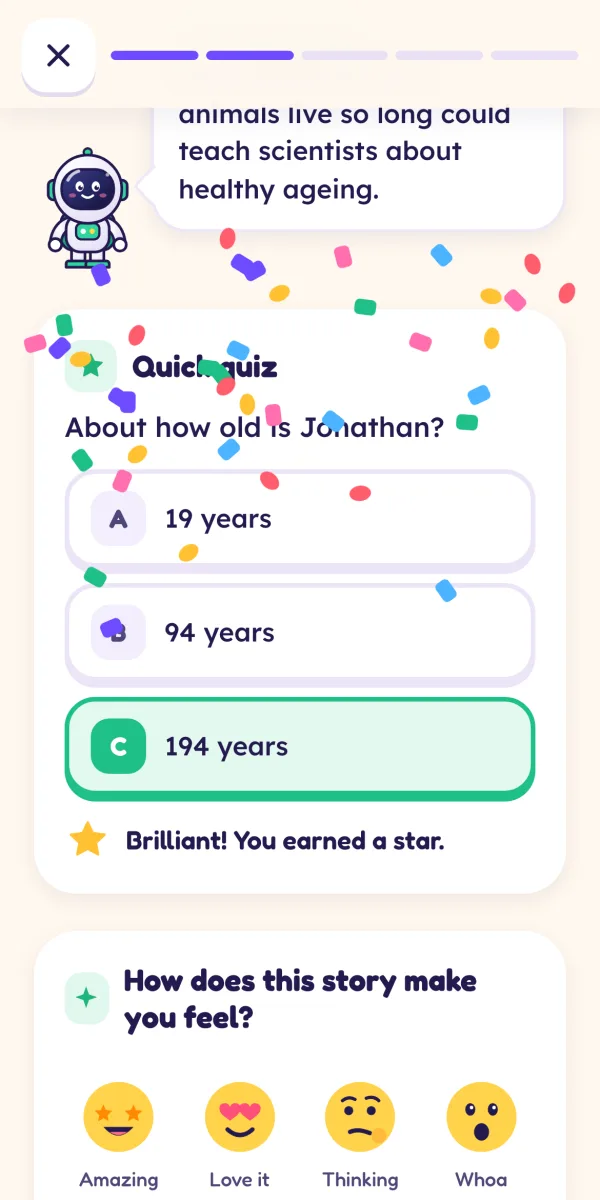
This is the habit Osmo is built around (it's our app, so we are biased). Each day there are five short stories from real science and technology publishers such as NASA, ESA and MIT News, each crediting and linking its source. Every story has a three-question quiz, and the stories are rewritten by AI at three reading levels, with a person on our team approving each one before children see it.
What should kids learn in the age of AI about using AI itself?
Children will use AI tools. The question is how. A real story we covered sums up the research well. Behavioural scientist Trent Cash of the University of Waterloo, quoted by Science News Explores, says: "If we offload a specific skill to AI, we're probably not going to retain that skill particularly well." Staying engaged, by learning from AI's feedback or examples, may build skills instead.
Turn that into family rules:
- Think first, then ask. Have a go before asking any tool.
- Ask AI to explain, not to do. "Explain why my answer is wrong" beats "write my answer".
- Check one thing. Verify at least one claim from any AI answer against a trusted source.
- Respect age rules. UNESCO's 2023 guidance suggested considering an age limit of 13 for generative AI in the classroom. Check each tool's own terms too.
Why kids need soft skills in the age of AI
It is tempting to assume the answer to AI is more technology lessons. The WEF data say otherwise. The top five core skills in 2025 are analytical thinking; resilience, flexibility and agility; leadership and social influence; creative thinking; and motivation and self-awareness. Not one of them is a technology skill. Kids need soft skills in the age of AI because collaboration, empathy and judgement are what people bring to work that machines assist with.
Soft skills grow through ordinary family life: chores that require teamwork, sport, looking after a younger sibling, settling a disagreement fairly, apologising, ordering at a shop. Don't outsource all of them to classes.
A weekly plan for busy families
| Day | Skill | 10-minute activity |
|---|---|---|
| Monday | Critical thinking | Read one science story; ask "How do we know?" |
| Tuesday | Communication | Your child teaches the family one thing they learned |
| Wednesday | Curiosity | Question jar at dinner; guess, then check together |
| Thursday | AI literacy | Spot one place AI is used today (maps, recommendations, voice) and talk about how it might get it wrong |
| Friday | Resilience | "Mistake of the week": everyone, parents included, shares one and what they learned |
| Weekend | Creativity | A make-something project with no instructions, 30 to 60 minutes |
That is about an hour a week in total. The point is not perfection. It is making these future skills for kids a normal part of family conversation.
The bottom line
The skills kids need in the age of AI are not mysterious, and they don't require you to be a technologist. Ask good questions, check claims, talk and listen, make things, understand the tools, and get back up after mistakes. The frameworks from Davos to Delhi point the same way. The good news for parents is that every one of these can be practised in ten minutes at home, starting tonight. For more on choosing good content, see our guide to science news for kids.
Frequently asked questions
What should kids learn in the age of AI?
Keep the basics (reading, maths, science) and add habits that AI cannot do for them: asking good questions, checking whether claims are true, explaining ideas clearly, making original things and recovering from setbacks. Children also need basic AI literacy: what AI is, how it learns from data, why it makes mistakes and when not to use it. Frameworks from UNESCO and the OECD say much the same.
Should my child learn coding to be ready for AI?
Coding is useful but it is not the whole answer. Computational thinking, which means breaking problems into steps, spotting patterns and testing ideas, matters more at young ages, and it can be learned through puzzles and games. CBSE is introducing computational thinking from Class 3 and AI concepts from Class 6 starting in 2026-27. Let interest lead, and add real coding when your child is keen.
How do I teach critical thinking for kids at home?
Make 'How do we know?' a family catchphrase. When you read a news story, an ad or a video claim, ask who said it, what evidence they have, and how you could check. Compare two sources. Praise your child for changing their mind when the evidence changes. Ten minutes a day with real, well-sourced news is excellent practice.
Do kids need soft skills in the age of AI?
Yes, arguably more than before. In the World Economic Forum's Future of Jobs Report 2025, employers ranked resilience, flexibility and agility second among core skills, with leadership and social influence third and empathy and active listening also in the top ten. These skills grow through conversation, teamwork, chores, sport and handling disagreements, not through apps alone.
Is it okay for children to use AI chatbots for homework?
Check the tool's age rules first. UNESCO's 2023 guidance suggested considering an age limit of 13 for classroom use of generative AI. For older children, the key is how they use it: research reported by Science News Explores suggests handing a whole task to AI weakens that skill, while learning from AI's feedback can strengthen it. Agree clear family rules.
Sources
- World Economic Forum: Future of Jobs Report 2025 (PDF)
- UNESCO: AI competency framework for students (2024)
- European Commission: New AI Literacy Framework helps schools prepare learners for the age of AI (EC and OECD, June 2026)
- UGC: Salient features of NEP 2020 (fundamental principles)
- Morung Express (PTI, 2026): CBSE rolls out curriculum on computational thinking, AI for Classes 3-8 from 2026-27
- UNICEF Innocenti: Preparing children for an AI world
- Stanford Graduate School of Education (2016): Stanford researchers find students have trouble judging the credibility of information online
- Science News Explores: Is AI making us dumber? (Trent Cash, University of Waterloo)
- UN News (2023): UNESCO calls for regulations on AI use in schools
Written and fact-checked by the Osmo Editorial Team. Osmo is not affiliated with the apps, publishers or organisations mentioned. Spotted something out of date? Tell us.