Quick answer
There is no single perfect news app for kids. India's best options split by job. For broad current affairs, RobinAge's kids newspaper (print or ₹99/month digital) is the most established. For Hindi, look at Bal Bharti, Chakmak and Champak. For daily science and technology at three reading levels, Osmo (our app) has a free daily edition.
- Kids newspapers in India cost roughly ₹160 to ₹2,500 a year.
- Hindi current affairs for children is still scarce; magazines fill the gap.
- NEP 2020 names current affairs as a skill every student should build.
- Check for ads, chat and data collection before any app goes on a child's phone.
If you have searched for a news app for kids, India-specific answers are hard to find. You have probably noticed the problem: most results are American or British, priced in dollars or pounds, and silent on Hindi. Meanwhile adult Indian news apps are loud, political and full of ads. This guide covers what Indian parents can actually buy or use in 2026, with rupee prices we checked on official pages in October 2026.
Disclosure: Osmo is our app, made by Neobound AI in Greater Noida. We have included it where it genuinely fits, and we are clear about what it does not cover.
What Indian parents should look for
A good kids news source for an Indian child needs to do a few things that global lists ignore.
- Indian context. Stories about ISRO, Indian scientists, Indian states and Indian sport, not only American politics.
- Language. English for school, and ideally Hindi or your home language too. NEP 2020 says the home language or mother tongue should be the medium of instruction wherever possible until at least Grade 5.
- Reading level. A Class 2 child and a Class 7 child need very different text.
- Safety. No ads, no chat with strangers, no scary headlines at bedtime.
- Price in rupees, with no surprise auto-renewals.
Kids newspaper India options: papers and magazines
India has a long tradition of children's publishing, and a good children's newspaper is still one of the best screen-free ways to build a news habit. These are the options we could verify as active in 2026.
| Publication | Language | Ages / classes | Frequency | Price when checked (Oct 2026) |
|---|---|---|---|---|
| RobinAge (print + digital) | English | 7 to 15 | Fortnightly, 24 issues a year | ₹2,499/year (listed down from ₹2,999) |
| Jr RobinAge (print + digital) | English | 4 to 7 | Fortnightly | ₹1,850/year (listed down from ₹1,999) |
| RobinAge digital only | English | 4 to 15 | Ongoing | ₹99/month (listed down from ₹199) |
| Champak | English or Hindi | 5 to 9 | 24 issues a year | ₹1,248/year (listed down from ₹1,560) |
| Bal Bharti (Publications Division) | Hindi | Children | Monthly | ₹160/year |
| Chakmak (Eklavya Foundation) | Hindi | About 7 to 15 | Monthly | See Eklavya's site |
| The Hindu Young World | English | Children | See The Hindu | See The Hindu |
RobinAge: the most established kids newspaper in India
RobinAge describes itself as "India's Favourite Newspaper for Children". It began in 2008, is published fortnightly for ages 4 to 15, and has a web version for readers worldwide. Each edition blends current affairs (India, world, green news, space, science, sport) with general knowledge and activity pages, and there is a separate Jr RobinAge for ages 4 to 7. Its site says it has won the KidsStopPress best newspaper and magazine award eight times between 2016 and 2025.
For a kids newspaper subscription on a budget, the ₹99 digital plan is the cheapest way to try it.
The Hindu Young World
The Hindu publishes Young World for children and runs the Hindu Young World Quiz, a live quiz for students in Classes 3 to 6 (junior) and 7 to 9 (senior), held as part of its Newspapers in Education work. We found conflicting prices from third-party sources, so check The Hindu directly before subscribing.
Champak, Bal Bharti and Chakmak
These are magazines rather than newspapers, so they are about stories, science and GK more than daily headlines. Champak has English and Hindi editions for ages 5 to 9. Bal Bharti is a Hindi children's monthly from the Government of India's Publications Division, priced at ₹160 a year on the government's Bharatkosh portal. Chakmak is a Hindi monthly from the Bhopal-based Eklavya Foundation, published since 1985, with a strong science focus.
Best news app for kids: India digital options
Few Indian apps are built purely for children's news. Here is what we could verify, including global options that work in India.
- RobinAge digital: the web version of the newspaper, ₹99 a month when we checked.
- Science News Explores: free, nonprofit science journalism in English for middle school and up. Excellent for Classes 6 to 9.
- Newsela: used by some schools. Its free Lite tier is only for teacher accounts, so ask your school.
- The Week Junior (UK): a weekly magazine for 8 to 14-year-olds. Its UK site lists worldwide delivery; check the overseas price.
- Osmo (ours): daily science and technology news, described below.
We could not confirm that some Indian kids news apps reported in earlier years are still running in 2026, so we have left them out. For a wider global comparison, see our guide to the best news app for kids worldwide.
Where Osmo fits
Osmo covers only science and technology: five short stories a day from publishers such as NASA, ESA, ScienceDaily and MIT News. AI rewrites each story at three reading levels (roughly Class 1 to 2, Class 3 to 5 and Class 6 to 9) using only facts from the original, and a person on our team approves every story before children see it. War, crime, politics and frightening topics are left out.
Indian science appears when the publishers cover it. This week, for example, ScienceDaily reported that researchers at the Indian Institute of Science used AI and computer simulations to study how CO2 can be turned into fuel on copper. That story is in Osmo at all three levels.
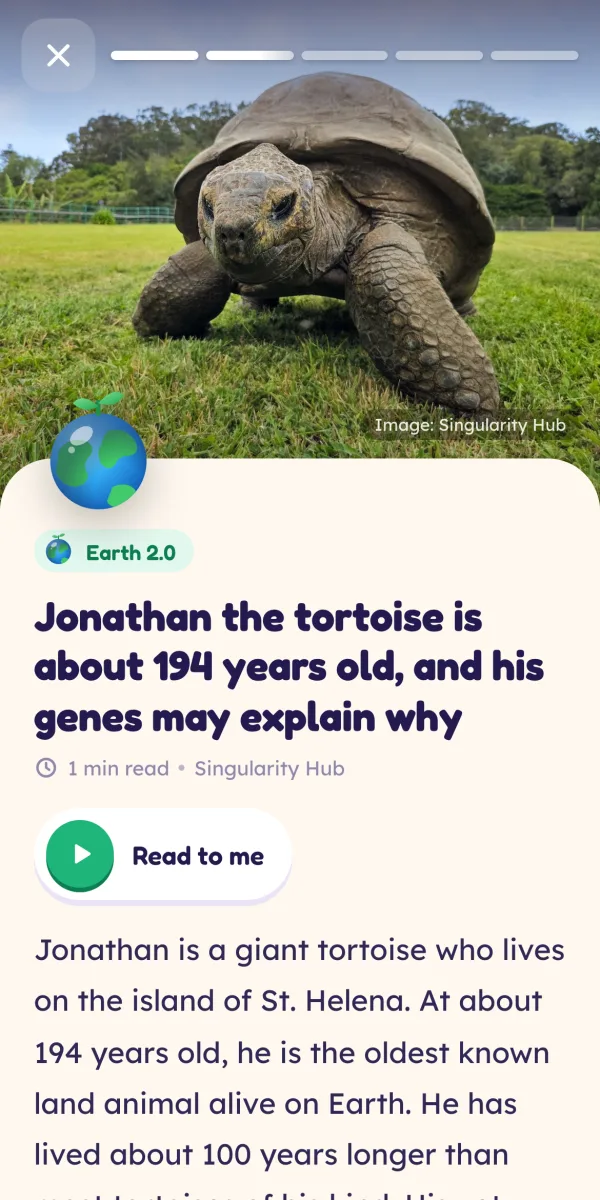
The free edition includes today's five stories, all three reading levels, read-aloud, quizzes and the last seven days. Osmo Plus, bought by a parent, adds stories in Hindi, a full archive, natural narration and printable worksheets, at ₹100 a month or ₹800 a year in India. Osmo works in any browser today, and the Android app is coming to Google Play.
Current affairs for kids in Hindi
This is the biggest gap in Indian children's media. Plenty of Hindi current affairs exists for competitive-exam aspirants, but very little is written for an eight-year-old. Here is what works today:
- Hindi magazines: Bal Bharti, Chakmak and Champak (Hindi) for regular reading.
- Translate together: read a short English kids story, then ask your child to retell it in Hindi. Retelling is a strong comprehension exercise in any language.
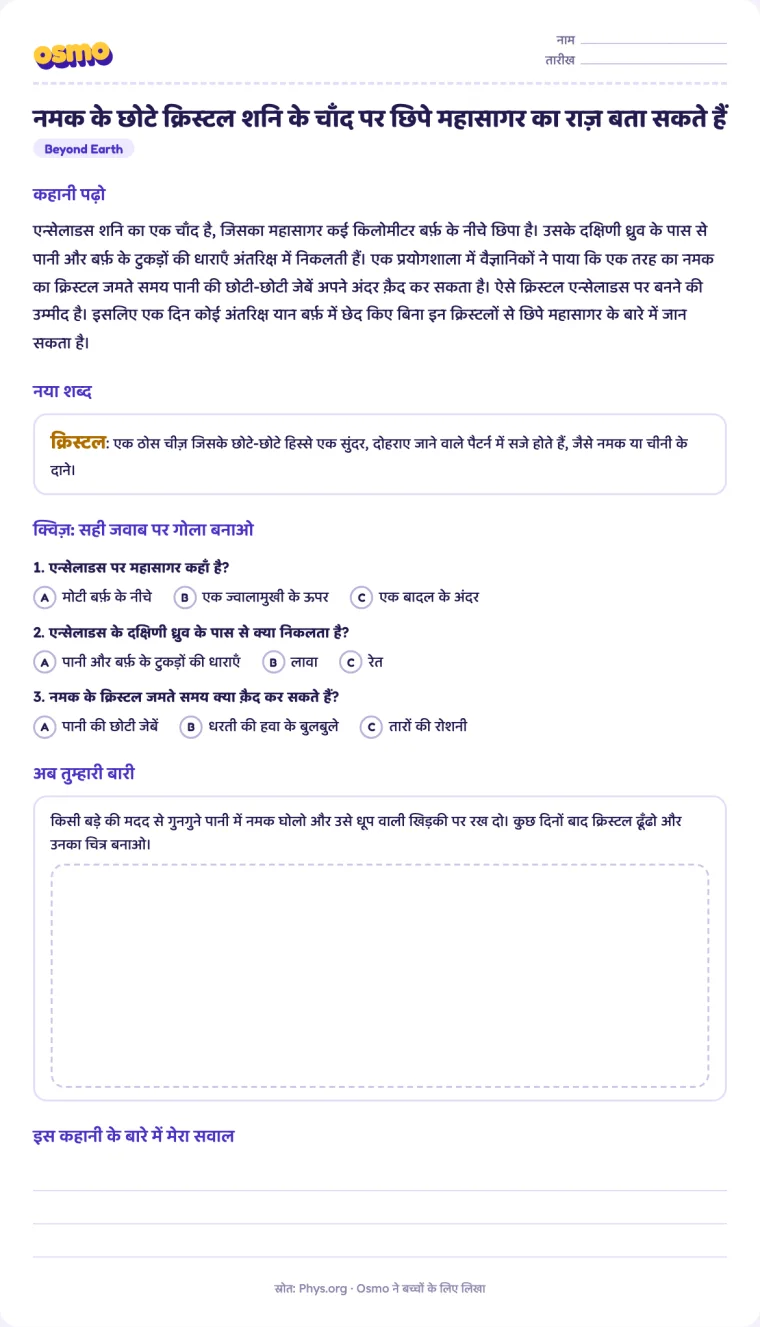
- Hindi science stories: Osmo Plus offers daily stories in Hindi. You can also print our free Hindi worksheet about Saturn's moon to see the format.
Does news reading help with CBSE and GK?
National Education Policy 2020 is explicit. In its list of skills all students should learn, it includes "scientific temper and evidence-based thinking" and "current affairs and knowledge of critical issues facing local communities, States, the country, and the world". It also calls for reducing curriculum content to core essentials "to make space for critical thinking" and discussion-based learning.
In practice, a regular news habit helps with:
- GK periods and quizzes, including competitions such as the Hindu Young World Quiz for Classes 3 to 9.
- Reading comprehension, because news gives fresh, unseen passages every day. See our guide to reading comprehension for Class 3.
- Science connections: a story about growth hormone and sleep links directly to what children learn about the human body.
It is a supplement, not a shortcut. Exam marks still come from the NCERT syllabus. Our current affairs for kids guide has a class-by-class plan and a real quiz with answers.
Safety: what to check before you download
India's Digital Personal Data Protection Act 2023 sets a clear direction. Section 9 says a data fiduciary must get verifiable consent from a parent before processing a child's personal data, and "shall not undertake tracking or behavioural monitoring of children or targeted advertising directed at children". Under the Act, a child is anyone under 18.
Whatever the legal timelines, you can apply that standard yourself today:
- Does the app ask for your child's name, phone number or email? Does it need to?
- Does it show ads, or "sponsored" content?
- Can children message or comment to each other?
- Are purchases and settings locked behind a grown-ups check?
- Can you delete your child's data easily?
For the full checklist, read our guide to safe news sites for kids. You can read how Osmo handles this on our privacy page: no accounts, no ads, no tracking SDKs and no chat.
Kids newspaper subscription or news app?
Many Indian families end up with both, and for good reasons. Each format does a different job.
| Print kids newspaper | News app | |
|---|---|---|
| Screen time | None | Some, so choose one with a clear end point |
| Freshness | Fortnightly or monthly | Daily |
| Reading levels | Usually one per edition | Often several, chosen per child |
| Read-aloud | A parent reads | Often built in |
| Sharing | Easy to pass to a sibling or take to school | Tied to a device |
| Typical cost | About ₹160 to ₹2,500 a year (see table above) | Free tiers exist; paid plans vary |
A practical rule: if your child is under 8, start with print or read an app story aloud together. From about Class 3, a short daily app edition plus a fortnightly kids newspaper subscription gives both habit and depth. By Class 6 to 8, add one source with real-world headlines, discussed together, so your child learns how news is made and how to question it.
A simple weekly news plan for Indian families
| Day | What to do | Time |
|---|---|---|
| Monday to Friday | One or two short stories with breakfast or after school | 5 to 10 minutes |
| Wednesday | Retell one story in Hindi or your home language | 5 minutes |
| Saturday | Read the kids newspaper or magazine together | 20 minutes |
| Sunday | Five-question family quiz from the week's stories | 10 minutes |
Keep it light. Whichever news app for kids, India-made or global, your family settles on, the goal is a child who asks "what's the news today?" on their own, not a child doing extra homework.
Frequently asked questions
Which is the best news app for kids in India?
It depends on what you want. For broad current affairs, RobinAge offers a kids newspaper with a ₹99 a month digital plan when we checked. For science and technology at three reading levels, Osmo (our app) has a free daily edition and Hindi stories in Osmo Plus. For school-linked reading, ask whether your child's school uses a platform such as Newsela.
Is there a newspaper for kids in India?
Yes. RobinAge is a fortnightly children's newspaper for ages 4 to 15, delivered across India, with a junior edition for ages 4 to 7. The Hindu runs Young World for children and the Young World Quiz for Classes 3 to 9. Magazines such as Champak, Bal Bharti and Chakmak add stories, science and general knowledge, some of them in Hindi.
Where can kids read current affairs in Hindi?
Dedicated Hindi news for children is still rare. Bal Bharti is a Hindi monthly from the Government of India's Publications Division, Chakmak is a Hindi monthly from the Eklavya Foundation with a strong science focus, and Champak has a Hindi edition. Osmo Plus offers daily science stories in Hindi. Reading a story together and discussing it in Hindi also works well.
How much does a kids newspaper subscription cost in India?
Prices we saw in October 2026: RobinAge print with digital access at ₹2,499 a year, Jr RobinAge at ₹1,850 a year, RobinAge digital only at ₹99 a month, Champak at ₹1,248 a year for 24 issues, and Bal Bharti at ₹160 a year. Many of these were sale prices, so check before paying.
Does reading the news help with CBSE and GK?
It can support it. NEP 2020 lists current affairs and knowledge of critical issues among the skills all students should learn, alongside scientific temper and evidence-based thinking. Regular news reading builds vocabulary, comprehension and general knowledge, which help in GK periods, quizzes and Olympiads, but it is not a substitute for the NCERT syllabus.
Sources
- RobinAge: About us
- RobinAge: Subscribe (plans and prices)
- Champak: official store and subscriptions
- Bharatkosh (Government of India): Bal Bharti subscription
- Eklavya Foundation: Chakmak magazine
- Wikipedia: Chakmak
- Wikipedia: Young World Quiz
- The Hindu: Children section
- Ministry of Education / PIB: NEP 2020 full text in resource book (paras 4.5 and 4.23)
- Digital Personal Data Protection Act 2023, Section 9 (text)
- Digital Personal Data Protection Act 2023, Section 2 (definitions)
- Common Sense Media: Best News Sources for Kids
- Science News Explores (Society for Science)
- The Week Junior UK (official subscription site)
- Newsela Help Center: Newsela Lite (Free Account)
Written and fact-checked by the Osmo Editorial Team. Osmo is not affiliated with the apps, publishers or organisations mentioned. Spotted something out of date? Tell us.