Quick answer
The best educational apps for 7 year olds and 6 year olds focus on three things: early reading, being read to, and number sense. Start with free Khan Academy Kids, add Read Along by Google for reading practice (including Hindi), and use apps together with your child rather than handing them over.
- Reading: Read Along by Google, Duolingo ABC, Teach Your Monster to Read.
- Read-aloud: Khan Academy Kids' Read To Me books, Epic, Osmo (our app) for real science stories.
- Maths: Khan Academy Kids, PBS KIDS Games, Kahoot! Algebra by DragonBox.
- How: short sessions, sit with them at first, and talk about what they saw.
Six and seven are the "it's clicking" years. In Class 1 and 2 (Grade 1 and 2 in the US), letters become words, words become sentences, and counting becomes adding and taking away. It is also when children start to want screens of their own.
This guide picks the best educational apps for 7 year olds and 6 year olds for exactly those skills, checked on each app's official page or store listing in October 2026. Then it covers the part most app lists skip: how to use these apps with a young child so they actually help. Osmo is our app; we have included it honestly, in the one place it fits.
What 6 and 7 year olds are learning
Child development guides describe the typical first-grader as able to do simple addition and subtraction and starting to read and write sentences. By seven, most children are becoming better readers, though sounding out vowels can still be hard. They can solve simple maths problems using objects such as counting beads, have a solid sense of time, and often think about problems "using only one factor at a time." They are also becoming more aware of other people's feelings.
India's NIPUN Bharat mission sets clear goals for these years:
| Stage | Reading goal | Maths goal |
|---|---|---|
| Grade 1 (about age 6) | Reads small sentences of at least 4 to 5 simple words in an unfamiliar, age-appropriate text | Reads and writes numbers up to 99; simple addition and subtraction |
| Grade 2 (about age 7) | Reads with meaning at 45 to 60 words per minute | Reads and writes numbers up to 999; subtracts numbers up to 99 |
Wherever you live, that is a useful yardstick. The best educational apps for 6 year olds give practice at the level your child is at now, with a little stretch, and nothing that needs fluent reading to navigate. At seven, the same apps can stretch a little further, into longer stories and two-digit sums.
Red flags at this age
- Ads or "watch a video to continue" buttons.
- Purchase prompts aimed at the child rather than the parent.
- Chat with strangers, or links that open a web browser.
- Streaks, countdowns or "come back tomorrow or lose your reward" messages.
You can check most of these on the store listing before you install: look for "Contains ads", the list of in-app purchases, and the privacy section.
Best educational apps for 7 year olds at a glance
| App | Best for | Ages | Cost |
|---|---|---|---|
| Khan Academy Kids | Reading, maths, read-aloud books | 2 to 8 | Free, no ads or subscriptions |
| Read Along by Google | Reading aloud with help, Indian languages | Early readers | Free (Android and web) |
| Duolingo ABC | Letters, phonics, sight words | Preschool to Grade 2 | Free, no ads or in-app purchases |
| Teach Your Monster to Read | Phonics games | Beginning readers | Free on computers; apps paid |
| Epic | Big library with read-to-me books | Rated 4+ | Subscription (free in school day) |
| StoryWeaver | Free multilingual storybooks | All levels | Free, openly licensed |
| PBS KIDS Games | Maths, reading and science games | 2 to 8 | Free |
| Kahoot! Algebra by DragonBox | Equation puzzles | From about 5 | Subscription |
| ScratchJr | First coding | 5 to 7 | Free |
| Osmo (ours) | Short real science stories, read to me | About 5 to 14 | Free daily edition, optional Plus |
Reading apps for 6 year olds and 7 year olds
Read Along by Google (free)
Children read stories aloud and a reading buddy helps with pronunciation when they get stuck. It is free as an Android app and on the web, runs offline on Android, and supports English, Hindi, Bangla, Marathi, Gujarati, Tamil, Telugu and Urdu among other languages. Profiles and their data stay on your device. A brilliant choice for Indian families who want reading practice in a home language.
Duolingo ABC (free)
Short lessons on the alphabet, phonics, sight words and vocabulary, with tracing and interactive stories that highlight each word as it is read aloud. The App Store listing says it covers preschool to second grade, has more than 700 lessons, works offline and has "no ads or in-app purchases." Check availability in your country's store.
Teach Your Monster to Read (free on computers)
A phonics game designed with academics at the University of Roehampton, in three stages from first letters to reading sentences confidently. It is completely free to play on laptops and computers; the mobile apps are paid.
Epic and StoryWeaver (libraries)
Once your child can read simple sentences, they need lots of books. Epic has more than 40,000 books, audiobooks and videos, including read-to-me titles, as a family subscription after a 7-day trial. StoryWeaver, from the Indian not-for-profit Pratham Books, is free and openly licensed, with stories in languages from India and beyond.
Read-aloud apps, and a little real science
Hearing a story while seeing the words is a gentle bridge for children who can decode a bit but tire quickly. Khan Academy Kids has a "Read To Me" library of read-aloud books in English or Spanish, and Duolingo ABC highlights words as they are spoken.
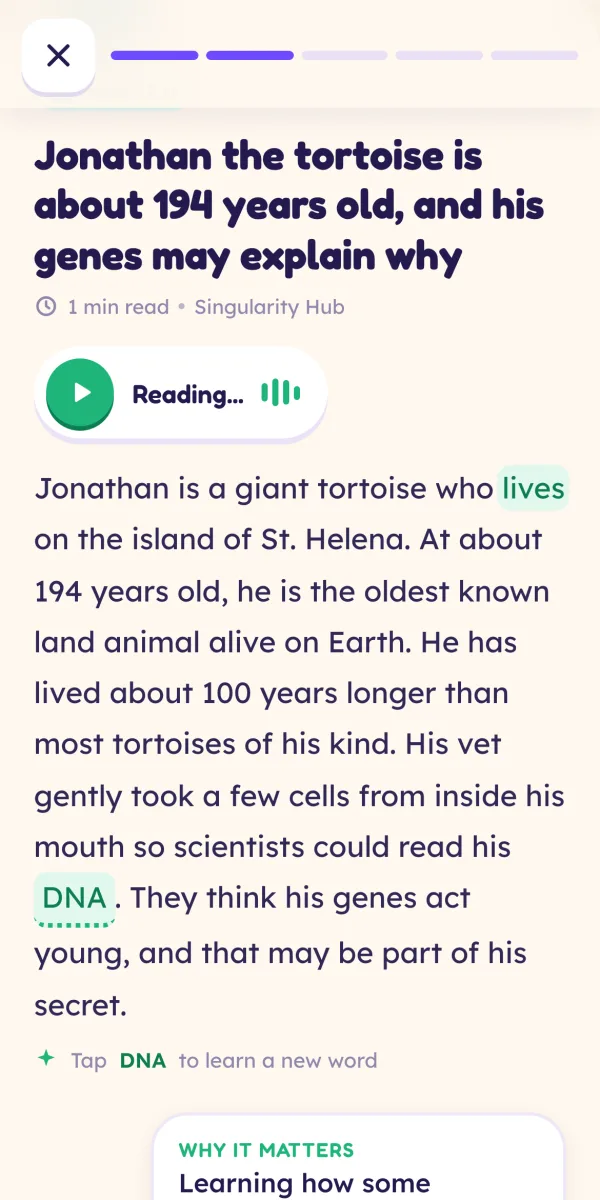
Osmo, our app, does the same with real science. Every day there are five short stories from publishers like NASA, ESA and ScienceDaily, rewritten by AI at three reading levels using only facts from the original, and approved by a person on our team. The youngest level (K to Grade 2, ages 5 to 7) is written for exactly this age. Here is a real one:
"Jonathan is a giant tortoise. He is about 194 years old! Scientists studied his body to learn why he has lived so long."
Tap Read to me and each word lights up as it is spoken. Tap any word for its meaning. Then a short quiz asks one simple question, like "About how old is Jonathan?" There are five stories, and then it is done for the day, with no endless feed and no streaks.
For a screen-free follow-up, print our free tortoise worksheet for K to Grade 2 or the baby walrus worksheet.
Maths and learning apps for 7 year olds
- Khan Academy Kids (free). Early maths alongside reading, in short guided activities. The easiest place to start.
- PBS KIDS Games (free). More than 280 games from PBS KIDS shows for ages 2 to 8, covering maths, reading, science and art, and you can download games to play offline.
- Kahoot! Algebra by DragonBox (subscription). Puzzles that quietly teach how equations balance, for children from about age five. It needs a Kahoot! Kids subscription after a 7-day trial.
- Prodigy Math (free, optional membership). Starts at Grade 1. Probably better from about seven, once your child reads question text comfortably.
- ScratchJr (free). Not a maths app, but snapping blocks into order to make a character move is sequencing, the root of both maths and coding. Designed for ages 5 to 7.
For more learning apps for 7 year olds sorted by science, technology, engineering and maths, see our guide to the best STEM apps for kids.
How to use apps together with a 6 or 7 year old
This is the part that matters most. The American Academy of Pediatrics says children "learn more about media when they share the experience with an adult," and suggests having kids guide you through their favourite games and asking what they built or saw. India's IAP guidance for ages 5 to 10 also says to co-view and monitor children's digital media.
Co-using does not mean hovering for every minute. Try this rhythm:
- First session: sit together. You hold the device. Check for ads, purchase buttons and anything that leads out of the app.
- Next few sessions: sit nearby. Your child drives. You ask questions.
- After that: same room, check in. Keep tablets in shared spaces, not bedrooms.
Things to say while you co-use
- "Can you show me how this works?"
- "Read me that sentence. Which word was tricky?"
- "How did you work that out? Could you do it with real blocks?"
- "What was the most surprising thing in that story?"
- "That's our last one. What shall we do next?" (Say this before the session ends, not after.)
The last line matters. The AAP advises against letting screens become a child's go-to whenever they are bored or frustrated, and the IAP goes further, calling boredom "the cauldron of imagination and creativity." Apps with a natural ending make the handover easier. For more ideas, see how to raise a curious child.
How much is enough at 6 and 7
- Total time: India's IAP recommends less than two hours a day for ages 5 to 10, the lesser the better, including screen time for school assignments.
- Move: the WHO recommends an average of at least 60 minutes a day of moderate to vigorous activity for ages 5 to 17, and limiting recreational screen time.
- Sleep: the AAP suggests putting devices away at bedtime, and the IAP advises switching screens off an hour before bed. The IAP says children aged 5 to 10 need 9 to 12 hours of sleep.
- Quality: no ads, no chat, no endless feed, and nothing your child needs to read fluently just to find the off button.
A simple plan for a seven-year-old: one 15-minute reading app session after school, one short maths game at the weekend, and a story together at bedtime from a real book. If you want a written family plan, our guide to educational screen time for kids has a template. When your child grows, our list of the best educational apps for 10 year olds picks up where this one ends.
The best educational apps for 7 year olds are the ones you barely notice: a few minutes of practice, a story that sparks a question, and then back to the real world.
Frequently asked questions
What is the best free learning app for a 6 year old?
Khan Academy Kids is the strongest all-rounder: made by the nonprofit Khan Academy for ages 2 to 8, covering early reading and maths, and 100% free with no ads or subscriptions. For reading practice in Hindi or other Indian languages, Read Along by Google is free and works offline on Android. PBS KIDS Games is a free bonus.
Which app is best for a 7 year old to learn to read?
It depends on where they are. If they are still sounding out words, a phonics game such as Teach Your Monster to Read (free on computers) or Duolingo ABC helps. If they can read simple sentences, Read Along by Google listens as they read aloud and helps with tricky words. Pair any app with a daily book read together.
How long should a 7 year old use learning apps?
India's Indian Academy of Pediatrics recommends less than two hours of total screen time a day for ages 5 to 10, including school-related screen time, and less is better. For a 7 year old, two or three focused sessions of 10 to 20 minutes, ideally with you nearby, are plenty. Avoid screens in the hour before bed.
Should I sit with my child while they use an app?
Especially at first, yes. The American Academy of Pediatrics says children learn more about media when they share the experience with an adult, and suggests having kids show you their favourite games. India's IAP guidance also recommends co-viewing for ages 5 to 10. Sitting in for the first few sessions also lets you check the app itself.
Are reading apps for 6 year olds as good as books?
Think of them as a supplement, not a replacement. A good app can give extra practice with letters and sounds, or read a story aloud while highlighting words. But reading a book together, talking about the pictures and asking what might happen next is something an app cannot fully copy. Use both, with the book first.
Sources
- Milestones for 7-Year-Olds (Healthwise / WebMD Ignite, via Kaiser Permanente)
- Cognitive Development, Ages 6 to 10 Years (Healthwise / WebMD Ignite, via Kaiser Permanente)
- NIPUN Bharat Mission (Ministry of Education, via PIB)
- Khan Academy Kids (official page)
- Khan Academy Kids on the App Store
- Read Along by Google (official site)
- Read Along Help: available languages
- Read Along Help: profiles
- Learn to Read: Duolingo ABC on the App Store
- Teach Your Monster to Read (official page)
- Epic: Kids' Books and Reading on the App Store
- Pratham Books (StoryWeaver)
- PBS KIDS Games on the App Store
- Kahoot! Algebra by DragonBox on the App Store
- Prodigy Math for parents
- ScratchJr on the App Store (Scratch Foundation)
- AAP / HealthyChildren.org: Watch Together, Co-Viewing Media With Your Child
- AAP / HealthyChildren.org: Kids and Screen Time, 5 C's Questions for School-Age Children
- Indian Academy of Pediatrics Guidelines on Screen Time and Digital Wellness (Indian Pediatrics, 2022)
- 2020 WHO guidelines on physical activity and sedentary behaviour for children and adolescents aged 5 to 17
Written and fact-checked by the Osmo Editorial Team. Osmo is not affiliated with the apps, publishers or organisations mentioned. Spotted something out of date? Tell us.